When someone is killed by another party's negligence in Texas, the law does not create one case. It creates two, and they are genuinely separate things rather than two labels for the same lawsuit. They are brought by different people, they compensate different losses, they are calculated differently, and, most consequentially for a grieving family, only one of them is exposed to the deceased person's creditors. Families routinely discover this at settlement, which is the worst possible moment to learn it.
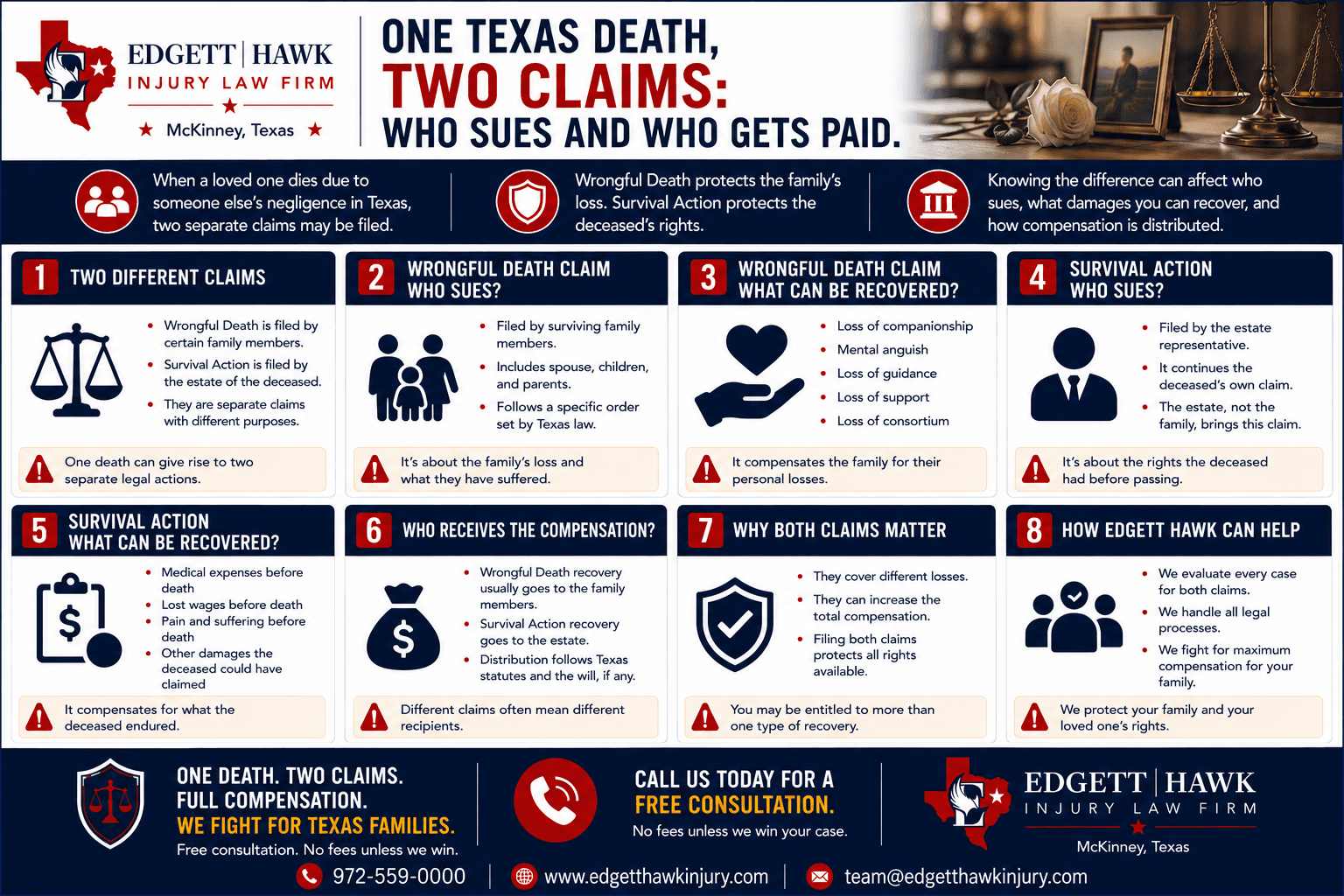
Two Claims, Side by Side
The clearest way to hold the distinction is to ask whose loss is being compensated. A wrongful death claim compensates the family for what they lost. A survival action compensates the deceased person for what they went through, with the recovery passing to their estate.
- Wrongful death, Subchapter A of Chapter 71: brought by the surviving spouse, children, and parents, for their own losses
- Survival action, Section 71.021: the deceased person's own personal injury claim, continued by the heirs, legal representatives, and estate
- Wrongful death damages: lost companionship and society, mental anguish, lost financial support, lost inheritance
- Survival damages: the pain and mental anguish the person suffered before death, their medical expenses, and funeral costs
- Wrongful death proceeds go to the beneficiaries personally. Survival proceeds go to the estate
Texas Allows Exactly Three Categories of Beneficiary
Section 71.004(a) is unusually blunt about this. The action is for the exclusive benefit of the surviving spouse, children, and parents of the deceased. Under subsection (b), any one of them may bring the action for the benefit of all. That list is closed, and the omissions matter enormously in practice:
- Siblings cannot bring a Texas wrongful death claim, no matter how close they were
- Grandparents cannot, even where they raised the deceased
- An unmarried partner cannot, unless the relationship qualifies as an informal marriage
- Stepchildren who were never adopted generally cannot
A family member outside that list is not without options, but their route runs through the estate and the survival claim rather than through wrongful death.
The Three Month Rule Nobody Mentions
Buried in Section 71.004(c) is a provision that changes who controls the litigation. If none of the individuals entitled to bring the action have begun it within three calendar months after the death, the executor or administrator shall bring and prosecute the action, unless all of those individuals request that they not do so. This is not the statute of limitations, which runs separately and much longer. It is a shift in authority. In a family that cannot agree on whether to sue, or that spends the first season after a death simply grieving, the decision can migrate to the estate representative without anybody realising it happened.
The Creditor Problem That Decides What the Family Keeps
This is the practical heart of the distinction. Wrongful death damages belong to the statutory beneficiaries in their own right, so they are not ordinarily reachable by the deceased person's creditors. Survival damages are recovered by the estate, and an estate is exactly where creditors go looking. Where someone died after a long hospitalisation, the medical debt can be substantial, and every dollar allocated to the survival claim rather than the wrongful death claim is a dollar those creditors may reach first. A settlement is usually a single number from one defendant, and how that number is allocated between the two claims is negotiable. Families who do not know the allocation is happening do not participate in it.
The Survival Claim Usually Requires Opening Probate
A wrongful death claim can be filed by a beneficiary directly. A survival claim belongs to the estate, which means somebody has to have authority to act for the estate before it can proceed properly. In practice that often means opening a probate administration, appointing an executor or administrator, and doing it while limitations continue to run in the background. Families sometimes assume no probate is needed because there was no house and no savings, forgetting that the claim itself is an estate asset. That assumption is one of the more common ways a survival claim gets left behind.
The Jury Decides Who Gets What, and It Is Not Even
Beneficiaries frequently assume a wrongful death recovery is divided in equal parts. Section 71.010 says otherwise. The jury may award damages in an amount proportionate to the injury resulting from the death, and the damages awarded shall be divided, in shares as found by the jury in its verdict, among the individuals entitled to recover who are alive at that time. Shares are set by the jury according to each person's actual loss. A spouse of thirty years and an adult child who had not spoken to the deceased in a decade are not in the same position, and the verdict form can say so explicitly. Where those interests genuinely conflict, beneficiaries occasionally need their own separate representation.
Punitive Damages Sit With the Wrongful Death Claim
Where the death resulted from a wilful act or omission or from gross negligence, Section 71.009 allows exemplary damages, and those are recoverable through the wrongful death claim. This matters in cases involving a drunk driver, a trucking company that ignored known safety failures, or a property owner who was warned repeatedly about a hazard. It is also another reason the allocation between the two claims deserves attention rather than being left to whoever drafts the settlement agreement. For how a defendant's share of responsibility is fixed in the first place, see
our guide to Texas comparative fault.
Two Clocks, Not One
Both claims are governed by the two year limitations period in Section 16.003 of the Civil Practice and Remedies Code, but they do not necessarily start on the same day. A wrongful death claim runs from the date of death. A survival claim continues the deceased person's own personal injury claim, which began when they were injured. Where someone was hurt in March and died the following February, those two dates are eleven months apart, and the survival claim is the one closer to expiring. Section 16.062 also suspends limitations for a period after a death in defined circumstances. None of this is worth working out alone under time pressure, which is the argument for getting advice early rather than at the anniversary. For the wider picture of what a Texas family faces after a fatal incident, see
our overview of Texas wrongful death claims.
Can Siblings File a Wrongful Death Claim in Texas?
No. Section 71.004(a) states that the action is for the exclusive benefit of the surviving spouse, children, and parents of the deceased. Brothers and sisters are not on that list, and neither are grandparents, cousins, or unmarried partners, regardless of how close the relationship was. A sibling serving as executor can still pursue the survival claim on behalf of the estate, which is a different claim with different damages.
What Is the Difference Between a Wrongful Death Claim and a Survival Action in Texas?
They compensate different losses suffered by different people. A wrongful death claim under Subchapter A of Chapter 71 belongs to the surviving spouse, children, and parents, and it compensates their own losses, such as lost companionship, mental anguish, and the financial support they would have received. A survival action under Section 71.021 is the claim the deceased person owned at the moment of death, continued by the estate, and it compensates what they themselves suffered before dying.
Can Creditors Take a Texas Wrongful Death Settlement?
Generally not from the wrongful death portion. Those damages belong to the statutory beneficiaries personally rather than to the estate, so they are not ordinarily available to pay the deceased person's debts. Survival action proceeds are different. They recover the deceased's own claim, they pass into the estate, and estate assets are exposed to creditor claims. How a settlement is allocated between the two claims therefore has real consequences for what the family keeps.
What Happens if the Family Does Not File Within Three Months in Texas?
The right to bring the case shifts. Under Section 71.004(c), if none of the individuals entitled to bring the action have begun it within three calendar months after the death, the executor or administrator shall bring and prosecute the action, unless all of those individuals request that they not do so. This is not the limitations deadline, which is separate. It is a rule about who controls the case.
Do Wrongful Death Beneficiaries Split the Money Equally in Texas?
No. Section 71.010 provides that the jury may award damages in an amount proportionate to the injury resulting from the death, and that the damages awarded shall be divided, in shares as found by the jury in its verdict, among the individuals entitled to recover who are alive at that time. A jury can give a surviving spouse and an adult child who was estranged very different shares, which is why beneficiaries sometimes need separate advice.
Ask Which Claim the Offer Is Paying
If a settlement has been discussed and nobody has explained how it splits between the wrongful death claim and the survival claim, that question needs asking before anything is signed, because the answer determines how much of it survives contact with the estate's creditors. Edgett Hawk handles fatal injury cases across North Texas, we bring both claims where both exist, and there is
no attorney fee unless we recover for you. Call 972.559.0000.