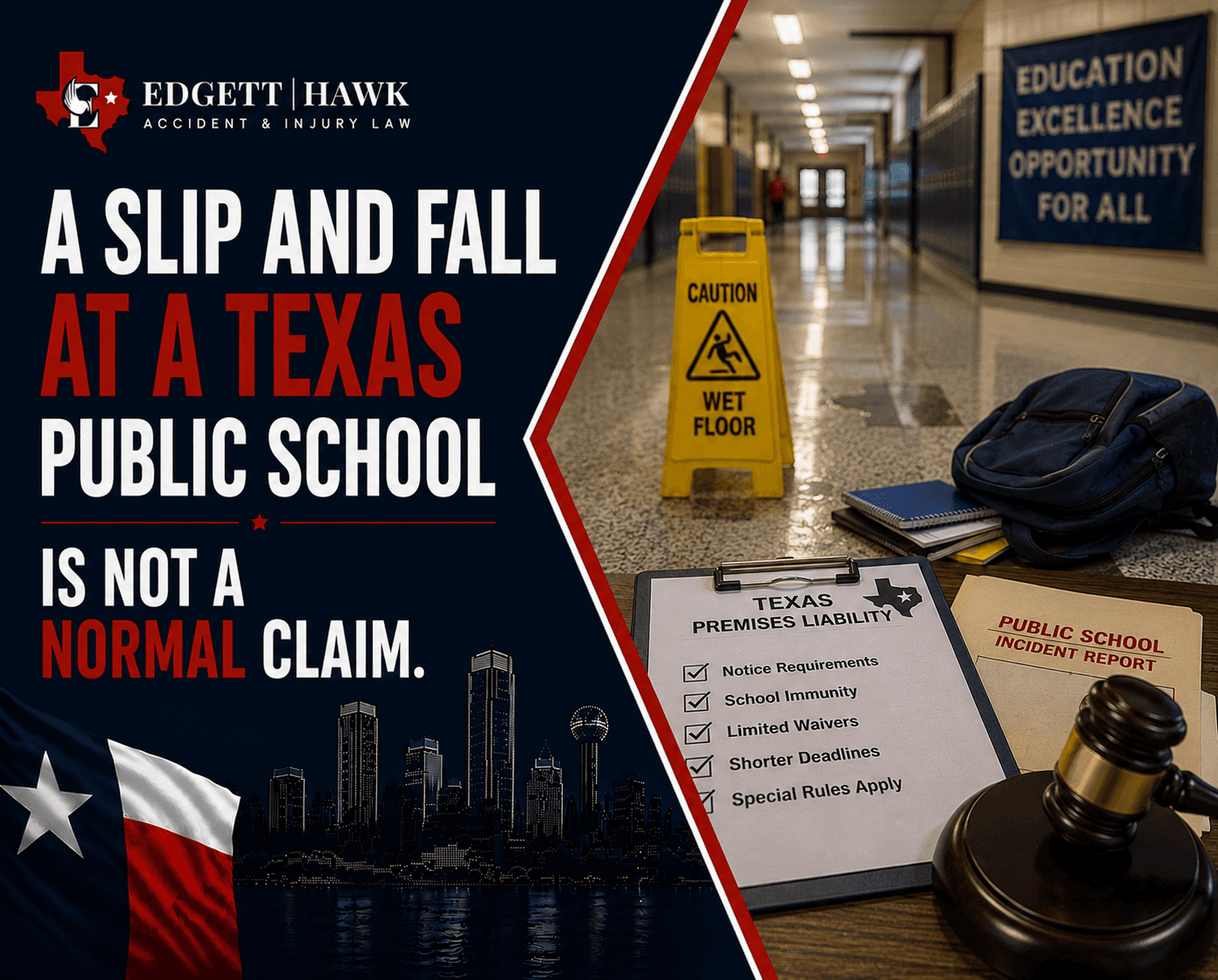
A fall in a supermarket and a fall in a school corridor look identical and are legally almost unrelated. In the supermarket you are an invitee and the occupier is liable for hazards it knew about or should have found. In a Texas public school, three separate layers of protection sit between the injury and any recovery, and the first of them closes the case outright in most instances. Parents are rarely told this, and by the time they find out, a short deadline they never knew about has usually expired.
The First Gate Closes Almost Everything
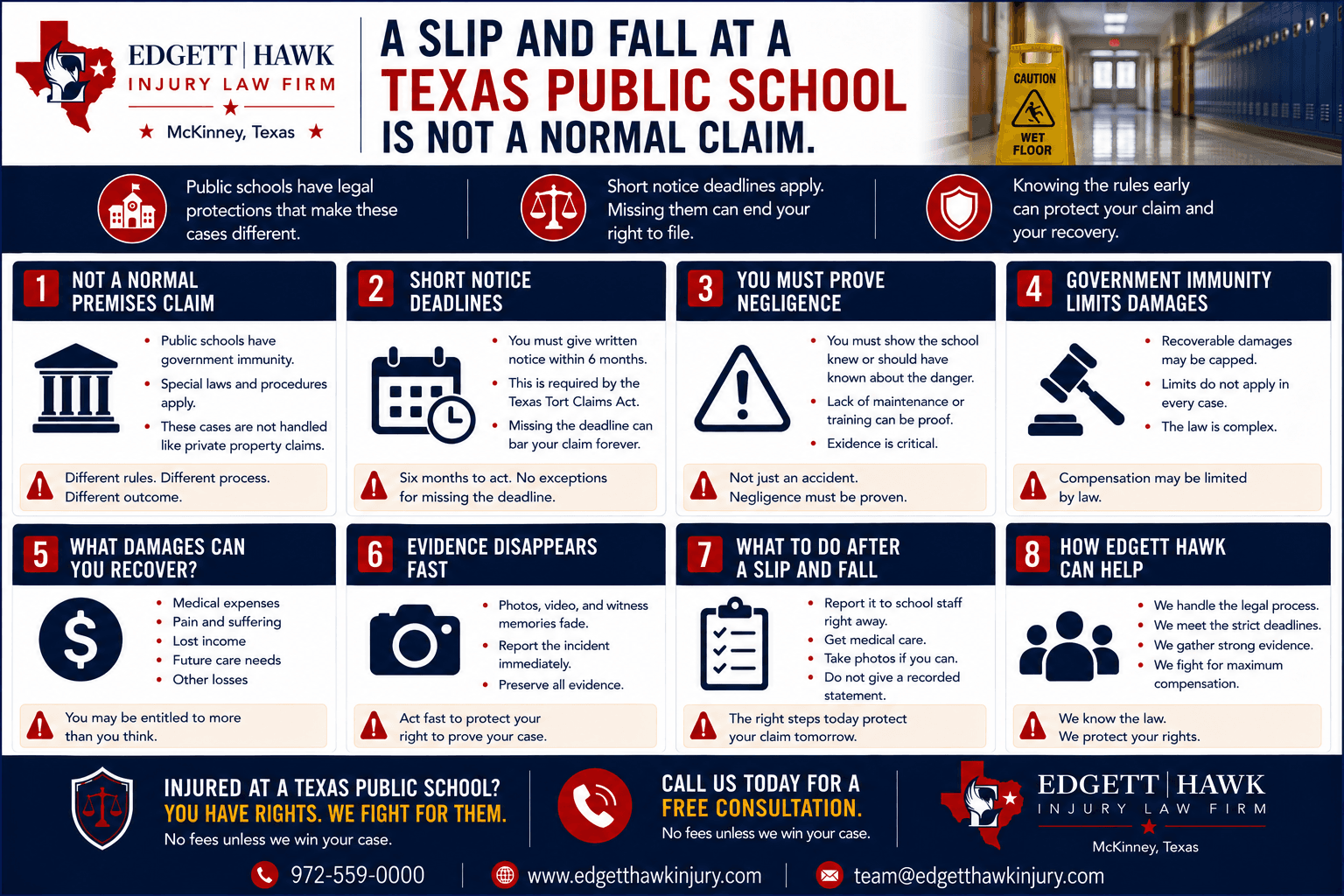
Texas school districts are governmental units, and the Tort Claims Act is normally how a governmental unit becomes suable. Section 101.051 removes that route with a single sentence: except as to motor vehicles, the chapter does not apply to a school district or to a junior college district. A premises claim involves no motor vehicle. That means a fall on a wet floor, a broken handrail, an unlit stairwell, or an uneven walkway generally cannot be brought against the district at all, no matter how obviously dangerous the condition was or how long it had been reported. This is not a reduced standard or a capped recovery. For most school premises claims it is a complete bar, and recognising that early is what stops a family spending six months pursuing the wrong defendant.
The Second Layer, for Governmental Units That Are Not Schools
It is worth understanding the standard that applies to other public premises, because a great many childhood falls happen at city recreation centres, municipal pools, and county facilities rather than on district land. Section 101.022(a) provides that where a claim arises from a premise defect, the governmental unit owes only the duty that a private person owes to a licensee on private property, unless the claimant pays for the use of the premises. The consequence is a much harder evidentiary burden:
- A licensee must show the unit had actual knowledge of the dangerous condition
- Constructive knowledge is not enough, so proving a reasonable inspection would have found it does not carry the claim
- Where the claimant paid to use the premises, the higher invitee duty can apply instead
- Section 101.022(b) excepts special defects such as excavations or obstructions on highways, which carry a greater duty to warn
Actual knowledge is usually proved from documents rather than argument. Prior complaints, work orders, maintenance logs, and incident reports about the same hazard are what turn a licensee claim from hopeless into arguable.
The Third Layer Applies to Playgrounds and Fields
Where the injury happened during recreation on public land, the duty can drop again. Section 75.002(f) provides that if a person enters premises owned, operated, or maintained by a governmental unit and engages in recreation on those premises, the governmental unit does not owe a greater degree of care than is owed to a trespasser. That is a lower duty than the licensee standard, and it is the most restrictive position in this area. Whether a given activity counts as recreation turns on the statutory definitions and on the facts, so it is not automatic, but a parent whose child was hurt on a playground or an athletic field should expect the argument to be made.
Private Schools Are a Completely Different Case
None of the above applies to a private school, because a private school is not a governmental unit. No Section 101.051 exclusion, no six month notice requirement, no statutory damages cap, and the ordinary premises liability framework applies with the visitor treated as an invitee. That means the school can be liable for a hazard it knew about or should have discovered through reasonable inspection, which is a far more realistic case to prove than actual knowledge. The elements are the same ones covered in
our guide to Texas premises liability. Establishing which kind of institution you are dealing with is therefore the first question, not a detail.
Where the Money Comes From When the District Is Immune
Immunity protects the district, not everyone who was involved. In a meaningful share of these cases another party had the actual responsibility, and that party has no immunity at all:
- A cleaning or janitorial contractor whose employee left a floor wet without signage
- A maintenance or construction company that installed or repaired the surface, stair, or rail
- The manufacturer of defective playground equipment or flooring
- A third party operating an after-hours programme or leasing the facility
- An independent transport provider, where a vehicle was involved
Identifying whether such a defendant exists requires the maintenance records and contracts, which is why a written preservation request in the first weeks matters more here than in an ordinary premises case.
The Caps, and Where They Actually Bite
Where the Tort Claims Act does apply, recovery is limited. Section 101.023(b) caps the liability of a unit of local government at 100,000 dollars for each person and 300,000 dollars for each single occurrence for bodily injury or death, with 100,000 dollars per occurrence for property damage. For state government the figures are 250,000 and 500,000. For a school district the caps are reached only in a motor vehicle claim, because Section 101.051 has already excluded everything else. A serious injury to a child can exceed 100,000 dollars in medical costs alone, which is why the existence of a non-governmental defendant frequently determines whether the family is made whole.
The Deadline That Runs While You Are Still Deciding
Where a governmental unit is a potential defendant, Section 101.101 entitles it to notice of the claim not later than six months after the day the incident occurred, describing the injury claimed, the time and place, and the incident. A city charter may lawfully require less. There is a saving provision where the unit has actual notice that death occurred, that the claimant received some injury, or that property was damaged, but treating it as a backstop is unwise. This is the trap that closes most school injury claims, and we cover it alongside the other seasonal risks in
our back to school injury guide.
What to Do in the First Fortnight
Because the identity of the correct defendant is the whole case, the early steps are about preserving the record rather than making demands.
- Get the child medically assessed the same day and follow through on referrals
- Photograph the exact location, the hazard, the lighting, and any signage or absence of it
- Ask in writing for the incident report and keep proof of the request
- Ask in writing who cleans, maintains, and inspects that area, and preserve the answer
- Note whether the building was being used by an outside organisation at the time
- Establish whether the institution is a public district, a charter, or private, because the answer changes everything
Can You Sue a Texas Public School for a Slip and Fall?
Usually not the district itself. Section 101.051 of the Civil Practice and Remedies Code provides that except as to motor vehicles, the Tort Claims Act does not apply to a school district or a junior college district. A wet corridor, a broken step, or an unlit stairwell involves no motor vehicle, so the ordinary route to suing a governmental unit is closed. The realistic question becomes whether a non-governmental defendant exists, such as a contractor, a maintenance company, or a product manufacturer.
Is a Private School Treated the Same as a Public School in Texas?
No, and the difference is enormous. A private school is not a governmental unit, so none of the Tort Claims Act applies to it. There is no six month notice requirement, no statutory damages cap, and the visitor is generally an invitee rather than a licensee, which means the school can be liable for hazards it should have known about through reasonable inspection, not only ones it actually knew about.
What Is the Licensee Standard for Texas Governmental Units?
Section 101.022(a) provides that where a claim arises from a premise defect, the governmental unit owes only the duty a private person owes to a licensee on private property, unless the claimant pays for the use of the premises. In practice that means proving the unit had actual knowledge of the dangerous condition. Constructive knowledge, the argument that a reasonable inspection would have found it, is not enough. Subsection (b) excepts special defects such as excavations or obstructions on highways, which carry a higher duty.
Does the Recreational Use Statute Apply to School Playgrounds in Texas?
It can, and it lowers the duty further. Section 75.002(f) provides that if a person enters premises owned, operated, or maintained by a governmental unit and engages in recreation on those premises, the unit does not owe a greater degree of care than is owed to a trespasser. Whether a particular activity counts as recreation depends on the statutory definitions, so this is fact specific, but where it applies it is a more restrictive standard than the licensee duty.
How Much Can You Recover From a Texas School District?
Where the Tort Claims Act applies at all, Section 101.023(b) caps the liability of a unit of local government at 100,000 dollars for each person and 300,000 dollars for each single occurrence for bodily injury or death, plus 100,000 dollars per occurrence for property damage. For a school district those caps are only reached in a motor vehicle claim, since Section 101.051 excludes everything else.
The Question Worth Asking on Day One
It is not whether the school was careless. It very often was. The question that decides these cases is whether anyone who can actually be sued was careless, and answering it means getting at contracts and maintenance records before they are archived. Edgett Hawk handles child injury and premises claims across North Texas, we identify the non-governmental defendant where one exists, and there is
no attorney fee unless we recover for you. Call 972.559.0000.