Two beliefs about Texas helmet law are widespread, and each is half right. Riders think that because Texas does not have a universal helmet requirement, going without one carries no consequences. Insurers act as though a bare head is an admission that ends the conversation. The accurate position is more specific than either. For a large share of Texas riders, not wearing a helmet is entirely lawful. And since a Texas Supreme Court decision in 2015 about seat belts, the door to arguing about it in a civil case has been open wider than most riders realise.
Texas Requires a Helmet, and Then Exempts Most Adults
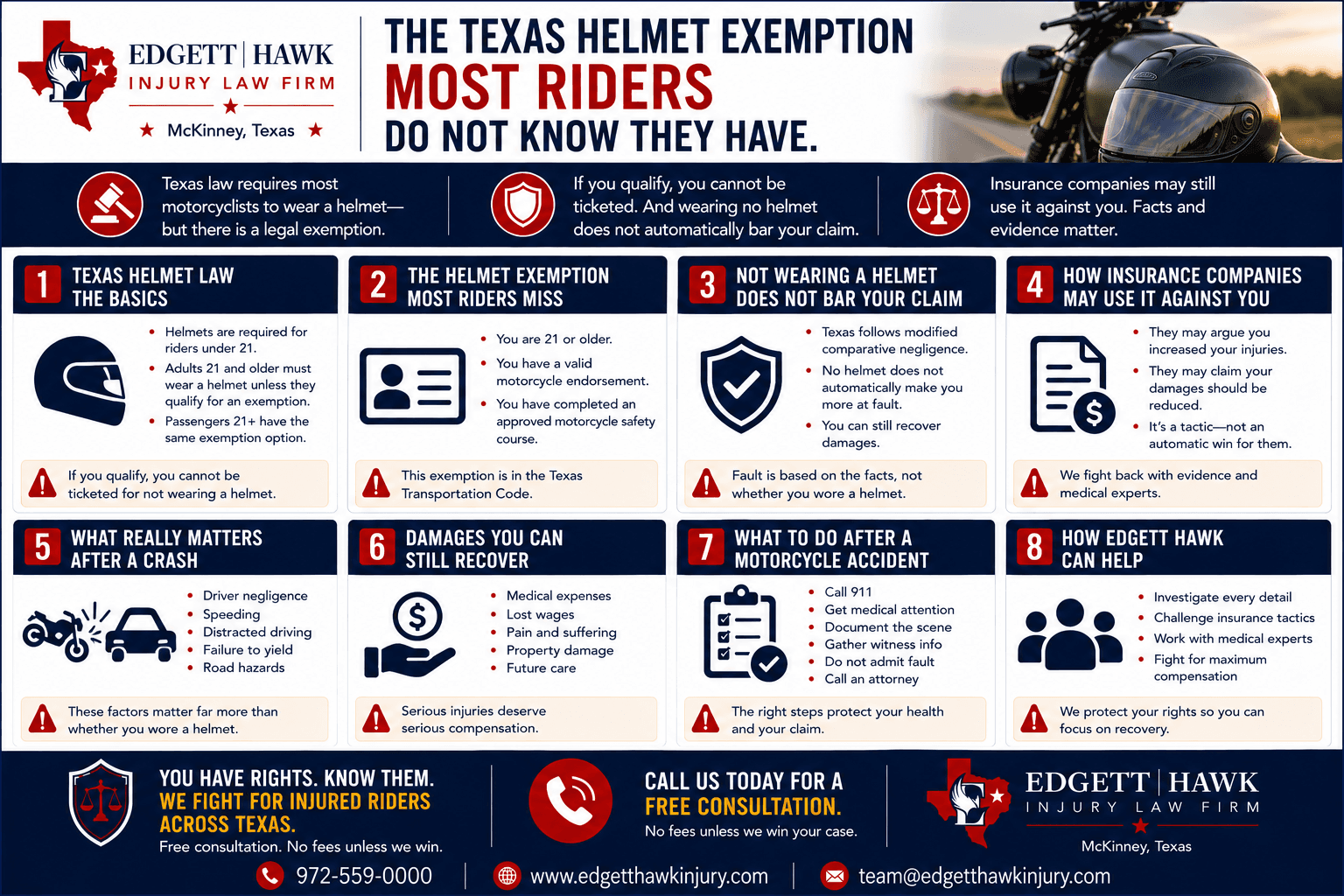
Section 661.003 of the Transportation Code starts strictly. A person commits an offence if they operate or ride as a passenger on a motorcycle on a public street or highway without protective headgear meeting the standards adopted by the department. The exemption immediately narrows that. A person at least 21 years old is not required to wear one if either of the following is true:
- They have successfully completed a motorcycle operator training and safety course
- They are covered by a health insurance plan providing for injuries incurred in a motorcycle collision
Note that this is an either or, not a both. A rider over 21 with qualifying health coverage is riding lawfully bare-headed even if they have never taken the course. The penalty where no exemption applies is modest, a misdemeanour with a fine between 10 and 50 dollars, which tells you the legislature treated this as a minor regulatory matter rather than serious misconduct.
An Officer Cannot Pull You Over to Check
The same section restricts enforcement in a way many riders do not know about. A peace officer may not stop or detain the operator of or a passenger on a motorcycle for the sole purpose of determining whether that person has completed the safety course or is covered by a health insurance plan. In practice this means the exemption cannot be used as a pretext for a stop, and an officer needs an independent lawful reason to pull a rider over before helmet status becomes their business at all.
There Is No Statute Keeping the Helmet Out of Your Case
This is where riders are most often misinformed, sometimes by articles written on this exact topic. Section 661.003 says nothing about civil litigation. It creates an offence, sets an exemption, restricts stops, and fixes a fine. It contains no provision declaring evidence of helmet use or non-use inadmissible in a civil trial. So the answer to whether you can still sue is yes, plainly and without qualification. The harder question is whether the defence can put your bare head in front of the jury, and that is answered somewhere else entirely.
What Changed in 2015, and Why It Matters to Riders
For forty years Texas excluded evidence that an injured person was not wearing a seat belt, under a 1974 decision called Carnation Co. v. Wong. In Nabors Well Services, Ltd. v. Romero, 456 S.W.3d 553, decided in 2015, the Texas Supreme Court overruled it. The court held that relevant evidence of use or non-use of seat belts, and relevant evidence of a plaintiff's pre-occurrence, injury-causing conduct generally, is admissible for the purpose of apportioning responsibility under the proportionate responsibility statute. That last phrase is deliberately broad, and helmet non-use sits squarely inside it. We cover how the seat belt version of this argument plays out in
our guide to Texas comparative fault.
The Honest Caveat on That Point
No reported Texas decision has applied Romero specifically to motorcycle helmets, so anyone telling you the question is settled either way is going further than the caselaw does. What can be said with confidence is that the reasoning is not limited to seat belts by its own terms, that defence counsel read it the same way, and that a rider should plan on the argument being made rather than assume a rule that no longer exists will keep it out.
The Limits Are Where a Rider's Protection Actually Lives
Romero did not create automatic reductions, and it did not make non-use into strict liability. The evidence is admissible only where the conduct caused or contributed to cause the damages being claimed, and that requirement does real work in a motorcycle case:
- A helmet protects the head, so the argument reaches head and brain injuries and nothing else
- Fractured legs, pelvic injuries, degloving, and internal trauma are outside it entirely
- The defendant carries the burden, and needs expert biomechanical proof that a helmet would have prevented or lessened this specific injury at this specific impact speed and angle
- Where the rider qualified for the statutory exemption, there was no violation at all, which weakens any suggestion the conduct was unreasonable
A defendant who applies one blanket percentage reduction across an entire claim, including the orthopaedic injuries, has not done that work and should be made to.
Which Makes the Exemption Paperwork Worth Having
If you are over 21 and rode without a helmet, the single most useful document in your file may be proof that you were entitled to. A completion certificate from a motorcycle operator training and safety course, or a health insurance policy in force on the date of the crash covering collision injuries, converts the discussion from unlawful conduct into lawful conduct that the legislature expressly permitted. That is a materially different starting point for the apportionment argument, and it is much easier to produce in the first month than in the eighteenth.
The Argument Underneath the Argument
Helmet evidence is attractive to insurers for a reason that has nothing to do with law. Jurors carry views about motorcyclists, and a bare head reinforces every one of them before a word of medical evidence is heard. That is why the point is often raised early and loudly in negotiation, well before anybody has produced a biomechanical expert who could actually support it. Recognising it as a pressure tactic rather than a legal conclusion is most of the defence. The same dynamic drives the lane position argument, which we cover in
our article on lane splitting and Texas motorcycle claims.
Is It Illegal to Ride Without a Helmet in Texas?
Not for everyone. Section 661.003 of the Transportation Code makes it an offence to operate or ride as a passenger on a motorcycle without approved protective headgear, but a person at least 21 years old is exempt if they have successfully completed a motorcycle operator training and safety course, or are covered by a health insurance plan providing for collision-related injuries. Where the exemption applies, riding without a helmet is lawful, and the penalty for a plain violation is a misdemeanour fine of between 10 and 50 dollars.
Can You Sue in Texas if You Were Not Wearing a Helmet?
Yes. No Texas statute bars an injured rider from bringing a claim because they were not wearing a helmet, and Section 661.003 contains no provision making helmet use or non-use inadmissible in a civil trial. What the absence of a helmet can do is give the defence an argument about how much of your injury it should have to pay for, which is a question of apportionment rather than a bar on suing.
Can a Defendant Use My Lack of a Helmet Against Me in Texas?
Very likely, though no Texas case has decided the point specifically for helmets. In Nabors Well Services, Ltd. v. Romero in 2015, the Texas Supreme Court overruled its earlier rule excluding seat belt evidence and held that relevant evidence of a plaintiff's pre-occurrence, injury-causing conduct generally is admissible for the purpose of apportioning responsibility. Helmet non-use fits that description, so expect the argument even though the caselaw has not yet caught up to it.
Can Not Wearing a Helmet Reduce Compensation for a Broken Leg?
It should not. The Romero rule reaches conduct that caused or contributed to cause the damages being claimed. A helmet protects the head, so the argument is confined to head and brain injuries that headgear would have prevented or lessened. Injuries a helmet would have done nothing about, such as fractures to the legs, pelvis, or arms, fall outside it, and a defendant who tries to apply a single across-the-board reduction to the whole claim is overreaching.
Can Police Stop a Texas Rider to Check Their Helmet Exemption?
No. Section 661.003 provides that a peace officer may not stop or detain the operator of or a passenger on a motorcycle for the sole purpose of determining whether the person has completed the motorcycle operator training and safety course or is covered by a health insurance plan. An officer needs some other lawful basis for the stop.
Find the Certificate Before You Answer Any Questions
If you were riding lawfully under the exemption, that fact should be established early and in writing, because it reframes every conversation that follows. If you were not, the argument is still confined to the injuries a helmet could actually have prevented, and the defendant has to prove that with expert evidence rather than assert it. Edgett Hawk handles motorcycle claims across North Texas, and there is
no attorney fee unless we recover for you. Call 972.559.0000.