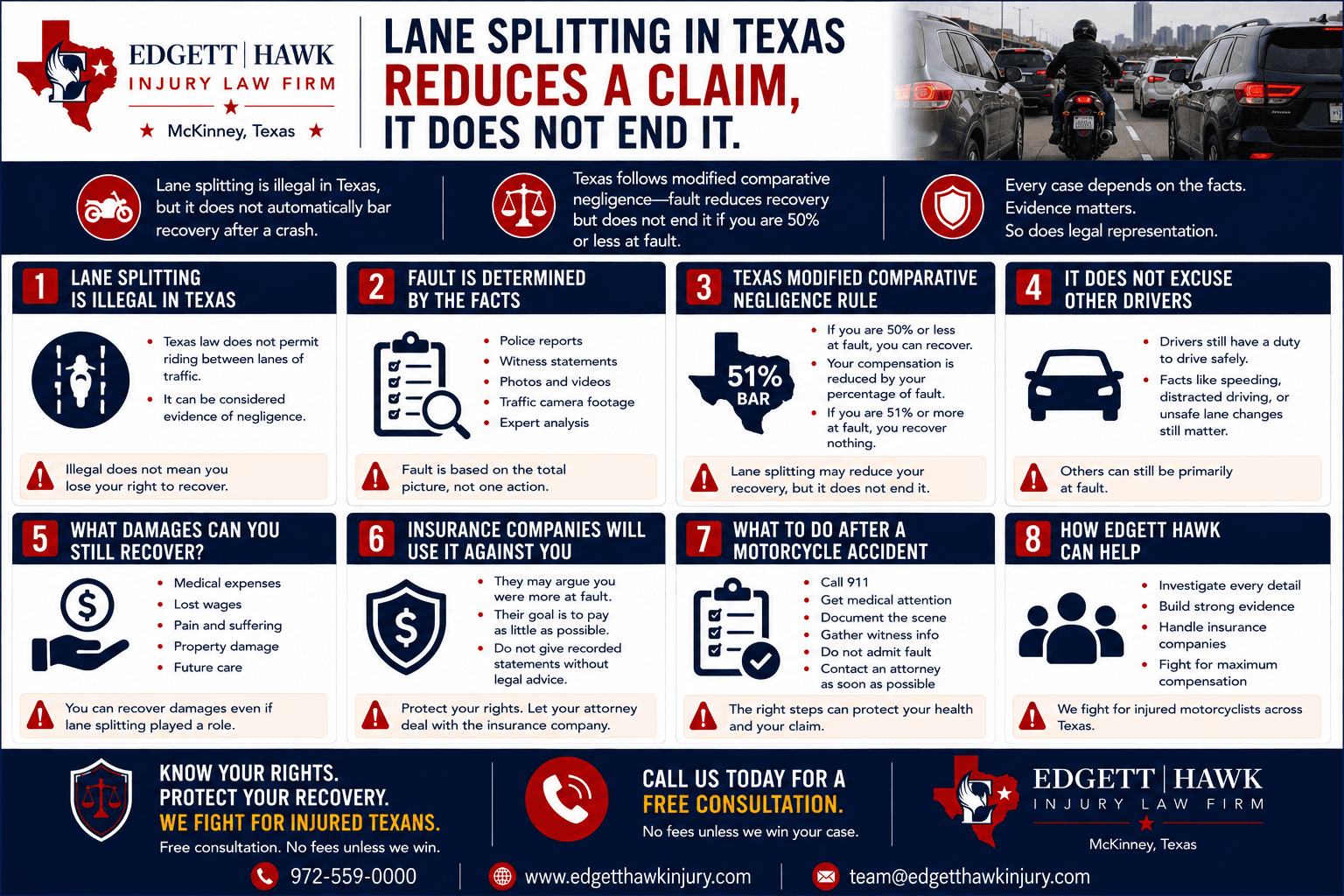
Two things get said after a lane splitting crash in Texas, and both are wrong. The rider is told the practice is a grey area and probably fine. The insurer tells them that because they broke the law, there is no claim. The accurate position sits between those. Texas banned lane splitting expressly in 2023, in a statute most articles on this subject still cite incorrectly, and that ban reduces what a rider recovers without removing the right to recover at all.
The Ban Lives in 545.0605, Not the Section Everyone Cites
Most articles on this topic point to Section 545.060, the general rule requiring any driver to stay as nearly as practical within a single lane. That was the provision used before 2023, because there was no motorcycle-specific ban to cite. There is now. House Bill 4122, passed by the 88th Legislature and effective 1 September 2023, added Section 545.0605, which deals specifically with motorcycles on a roadway laned for traffic. Under subsection (a)(3), an operator may not:
- Operate between lanes of traffic moving in the same direction
- Pass a motor vehicle while in the same lane as the vehicle being passed
- Operate more than two abreast in a single lane with other motorcycles
Subsection (b) excepts peace officers performing official duties. If a report, an adjuster, or an article tells you the rule comes from Section 545.060, they are working from the pre-2023 position.
The Same Statute Also Protects Riders
This is the half riders are rarely told about. Section 545.0605(a)(1) entitles a motorcycle operator to full use of a lane and provides that a motor vehicle may not be driven in a manner that deprives a motorcycle of the full use of a lane. Subsection (a)(2) permits two motorcycles to operate abreast in a single lane with each other. So the driver who edges into a rider's lane, crowds them toward the shoulder, or treats a motorcycle as occupying only half a lane has violated a specific statutory duty. In a case where the insurer is loudly focused on what the rider did, that provision is frequently the more useful one.
Filtering Is Not a Separate Category in Texas
Riders often distinguish lane splitting, moving between lanes at speed, from lane filtering, easing between stopped or crawling traffic at a light. Some states treat those differently. Texas does not. Both involve operating between lanes of traffic moving in the same direction, and both fall inside the same prohibition. That nearly changed. House Bill 2957 in the 2025 session would have allowed a narrow filtering exception on divided highways with at least two lanes in each direction, only where the traffic being passed was stopped or moving at 10 miles per hour or less, and only at a motorcycle speed of 20 miles per hour or less. It was referred to committee in March 2025, was left pending without a floor vote, and died when the session ended in June. The proposal is worth knowing about because it tells you what a future Texas filtering law would probably look like, but it is not the law today.
Breaking a Traffic Law Is Not the End of a Claim
Insurers lean hard on the illegality, because it sounds decisive. It is not. Texas apportions responsibility rather than assigning it to one person. Under Section 33.001 of the Civil Practice and Remedies Code a claimant recovers nothing only where their percentage of responsibility is greater than 50 percent, and below that threshold damages are reduced by that percentage rather than eliminated. A rider assessed at 30 percent for splitting still recovers 70 percent of their damages. The whole contest becomes the number, which is exactly the dynamic we describe in
our guide to Texas comparative fault.
What Pushes the Rider's Percentage Down
Because the argument is about proportions, the driver's conduct matters just as much as the rider's. The facts that move the split are usually these:
- A lane change made without signalling, which Section 545.104 requires
- A lane change made without a mirror or shoulder check, where the motorcycle was visible for several seconds
- Phone use at the moment of the manoeuvre, provable from records
- Crowding the rider's lane before the impact, contrary to Section 545.0605(a)(1)
- Speed differential, since a driver moving quickly into a gap contributes more than a rider passing slowly through stopped traffic
Being Cited Does Not Settle Anything
A citation at the scene feels conclusive and is not. The officer usually arrived after the collision, and in a motorcycle crash the only account available at that moment is often the driver's, because the rider is being loaded into an ambulance. Fault for civil purposes is determined by the trier of fact under Chapter 33 on all the evidence, and reconstruction, camera footage, and vehicle data routinely produce a different picture from the one recorded at the roadside. A citation is a piece of evidence to be weighed against the rest, not a finding that binds anybody.
The Bias That Sits Underneath Every One of These Cases
Motorcycle claims carry a jury problem that car claims do not. A meaningful share of people assume riders are reckless before hearing any facts, and adjusters know it, which is why offers in motorcycle cases often start lower relative to injury severity than they would for the same injuries in a car. Countering it is done with specifics rather than sympathy: the exact position of both vehicles, the signal timing, the sight lines, and the rider's own record. Where the rider was licensed, endorsed, trained, and visible, those facts belong in the file early.
Evidence That Decides the Percentage Disappears Quickly
Motorcycles are usually total losses and get released for salvage fast, taking their physical evidence with them. Damage patterns showing the angle of impact, gouge marks locating the point of contact, and the position of debris are what establish whether the rider was between lanes at all, or whether the car crossed into a lane the rider was lawfully occupying. Helmet camera and dashcam footage from other vehicles is overwritten within weeks. Because the outcome turns on a percentage rather than a yes or no, and percentages are argued from physical evidence, the first fortnight matters more here than in almost any other kind of claim.
Is Lane Splitting Legal in Texas?
No. Since 1 September 2023, Section 545.0605(a)(3) of the Transportation Code expressly prohibits operating a motorcycle between lanes of traffic moving in the same direction, and also prohibits passing a motor vehicle while in the same lane as the vehicle being passed. Before that amendment there was no motorcycle-specific ban and citations were written under the general single lane rule instead. Peace officers performing official duties are excepted.
Can You Still Sue if You Were Lane Splitting in Texas?
Yes. Being cited or breaking a traffic law does not remove your right to bring a claim. Under Section 33.001 of the Civil Practice and Remedies Code your damages are reduced by your percentage of responsibility, and you recover nothing only if your share is greater than 50 percent. A rider found 30 percent responsible for splitting still recovers 70 percent of their damages from the driver who caused the collision.
Is Lane Filtering Legal in Texas?
No. Lane filtering, moving between stopped or very slow traffic, is covered by the same prohibition as lane splitting. House Bill 2957 in the 2025 session would have permitted a narrow version of it, limited to divided highways with at least two lanes in each direction, only where the traffic being passed was stopped or moving at 10 miles per hour or less, and only at a motorcycle speed of 20 miles per hour or less. It was referred to committee in March 2025, was left pending, and died when the session ended.
Can a Car Legally Drive Beside a Motorcycle in the Same Lane in Texas?
No. Section 545.0605(a)(1) entitles a motorcycle operator to full use of a lane and prohibits a motor vehicle from being driven in a manner that deprives a motorcycle of the full use of that lane. The one express exception is that two motorcycles may operate abreast in a single lane with each other. This cuts both ways in a crash investigation, because a driver who crowded a rider has violated a specific statute of their own.
Does a Traffic Ticket Decide Fault in a Texas Motorcycle Accident?
No. A citation is evidence, not a verdict, and the officer who wrote it usually did not witness the collision. Fault in a civil claim is determined separately by the trier of fact under Chapter 33, based on all the evidence including physical scene data. Riders are frequently cited at the scene because the driver's account is the only one given while the rider is being taken to hospital.
Do Not Concede the Percentage Before Anyone Has Measured It
The most damaging thing a rider does after one of these crashes is accept the framing that being in the wrong place ends the conversation. It does not. It sets a number, and that number is negotiable against everything the driver did. Edgett Hawk handles motorcycle claims across North Texas, we get to the bike before it is salvaged, and there is
no attorney fee unless we recover for you. Call 972.559.0000.