The phrase every dog owner in Texas repeats is that a dog gets one free bite. It is a bad summary of a real rule, and believing it costs injured people cases they could have won. Texas has no dog bite statute at all. What it has is a common law standard about what the owner knew, and a completely separate negligence route that does not care about the dog's history in the slightest. Most people only ever hear about the first one.
The Rule Comes From a Case About a Hog
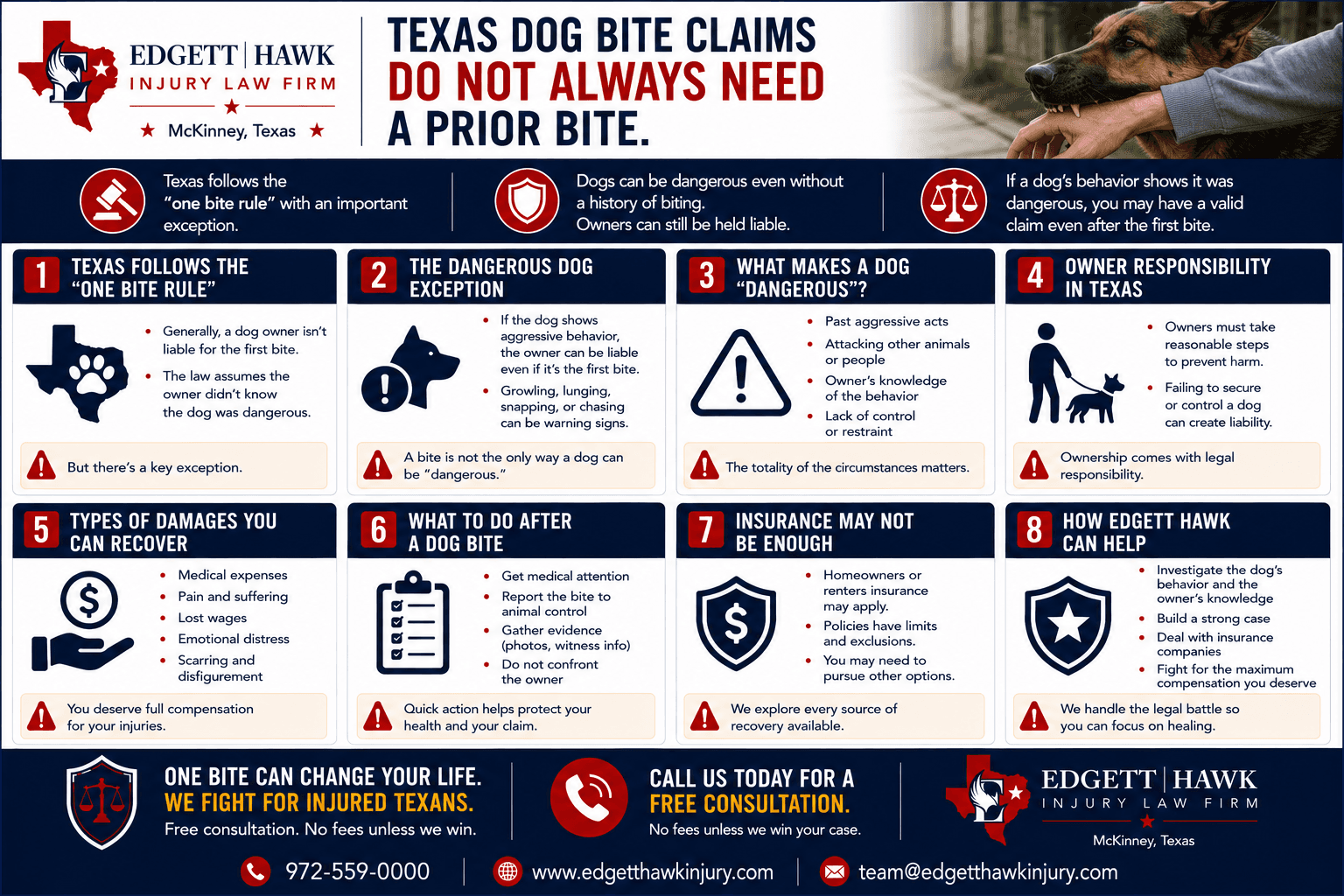
Marshall v. Ranne, decided by the Texas Supreme Court in 1974, is the source of what everyone now calls the one bite rule, and it did not involve a dog. It involved a vicious hog that attacked a man and badly injured his hand. The court adopted the standard that a possessor of an animal which he has reason to know has dangerous propensities abnormal to its class is subject to liability for harm it causes to others, other than trespassers on his land, even if he exercised the utmost care to prevent it. Texas courts have applied that standard to dogs ever since. Note what the rule actually requires and what it does not. It requires knowledge of a propensity. It says nothing about a bite, and it says nothing about counting incidents.
Knowledge Is the Element, Not the Bite Count
The Marshall standard turns on whether the owner knew or had reason to know. The court treated actual knowledge and constructive knowledge as functionally the same, finding no essential distinction between the Restatement's phrase has reason to know and the phrase should have known used in the jury question. That opens the evidence well beyond a bite history:
- Prior attacks or bites, whether or not anyone reported them
- Growling, lunging, snapping, or charging a fence at passers-by
- Straining hard on a leash toward people or other animals
- The owner's own warnings, including telling visitors to keep back
- Training the dog for protection, guarding, or aggression
- Complaints to a landlord, an HOA, or animal control
Neighbours, delivery drivers, and postal workers are usually the people who saw this behaviour, and they are rarely asked unless somebody goes looking for them early.
The Second Route Ignores the Dog Entirely
This is the part the one bite framing hides. Negligence is a separate cause of action, and it asks a different question: did the owner handle this animal the way a reasonably prudent person would have. No knowledge of dangerous propensities is required, because the claim is not about the dog's character. It is about the owner's conduct. A gate left unlatched, a tether or collar that was visibly inadequate, a dog off leash where a municipal ordinance requires one, or a front door opened to a stranger while a large dog was loose in the hallway can all support it. A first-time incident with a genuinely friendly dog can still be somebody's fault.
Local Leash Ordinances Do Real Work Here
Texas has no statewide leash law, so this is governed municipally, and most North Texas cities have an ordinance requiring dogs to be restrained or confined. Where a violation of that ordinance caused the injury, it can support a negligence per se theory, which shifts the argument from whether the owner behaved reasonably to whether they complied with a rule that already defines reasonable conduct. That is a materially easier case to prove. It is also why the first thing worth checking is the ordinance for the specific city where the attack happened, since they are not uniform across the Metroplex.
Chapter 822 Is Not How You Get Paid, but It Helps
The Health and Safety Code regulates dangerous dogs, and people often assume it is the basis for a damages claim. It is not. What it does is create a formal record. Section 822.041 defines a dangerous dog as one that makes an unprovoked attack causing bodily injury in a place other than an enclosure reasonably certain to keep it contained, or that commits unprovoked acts outside such an enclosure causing a person to reasonably believe it will attack and cause bodily injury. Once the owner knows of such an attack, or a court or the animal control authority informs them the dog is dangerous, Section 822.042 imposes duties including registration and secure confinement, with 30 days to deliver the dog to animal control if they do not comply. For a civil claim, the value is evidentiary. A prior dangerous dog determination is close to conclusive proof of the knowledge that a strict liability claim needs.
There Is Criminal Exposure Too
Section 822.005, known as Lillian's Law after Lillian Stiles, who was killed by loose dogs while mowing her lawn, makes it an offence for an owner to be criminally negligent in failing to secure a dog that then makes an unprovoked attack away from the owner's property causing serious bodily injury. That is a third degree felony, and a second degree felony where the attack causes death. A criminal case runs on its own track and does not compensate the victim, but the investigation behind it generates statements, animal control records, and findings that a civil claim can use.
The Defences You Should Expect
Two arguments come up in almost every case. The first is provocation, which is aimed at reducing or eliminating recovery by putting responsibility on the injured person, and which carries much less weight where the victim is a young child. The second is trespass, since the Marshall rule expressly excludes trespassers on the owner's land, so where the attack happened and whether the person was invited becomes central. Both feed into proportionate responsibility, where your damages fall by your percentage of fault and disappear entirely above 50 percent, as set out in
our guide to Texas comparative fault.
Where the Money Usually Comes From
Most dog bite recoveries in Texas are paid by a homeowners or renters insurance policy rather than by the owner personally, and that changes the practical shape of the case. It means the question of whether the owner can afford to pay is often the wrong question. It also means an adjuster is involved from early on, frequently before the injured person has finished treatment, and that scarring and infection risk are commonly undervalued in a first offer because they are still developing. Photographing wounds at intervals through healing, rather than once at the emergency room, is the single most useful thing a victim can do for their own claim.
Does a Dog Get One Free Bite in Texas?
Not in any reliable sense. The phrase comes from the rule in Marshall v. Ranne, where the Texas Supreme Court held that a possessor of an animal with dangerous propensities abnormal to its class is liable for the harm it causes if the possessor knew or had reason to know of those propensities. A prior bite is one way to prove that knowledge, but it is not the only way, and a dog with no bite history can still fail the test through growling, lunging, straining, or guard training the owner knew about.
Is There a Dog Bite Statute in Texas?
There is no civil dog bite statute. Liability comes from common law, principally the strict liability rule adopted in Marshall v. Ranne and ordinary negligence. Chapter 822 of the Health and Safety Code regulates dangerous dogs and creates criminal exposure under Section 822.005, but it is not the basis on which an injured person recovers damages.
Can I Sue a Dog Owner in Texas if the Dog Never Bit Anyone Before?
Yes, through negligence rather than strict liability. That route asks whether the owner handled the animal as a reasonably prudent person would have, and it does not require any knowledge of dangerous propensities. An unsecured gate, a dog let off leash where an ordinance requires one, a failed tether, or a door opened while a large dog was loose in the hallway can each establish it without a single prior incident.
What Makes a Dog Legally Dangerous in Texas?
Section 822.041 defines a dangerous dog as one that makes an unprovoked attack causing bodily injury in a place other than a secure enclosure, or that commits unprovoked acts outside such an enclosure causing a person to reasonably believe the dog will attack and cause bodily injury. Once an owner knows of such an attack, or a court or the animal control authority tells them the dog is dangerous, the requirements in Section 822.042 apply, including registration and secure confinement.
Does a Beware of Dog Sign Protect the Owner in Texas?
It usually does the opposite. A warning sign is evidence that the owner believed the dog posed a risk, which is precisely the knowledge element a strict liability claim has to establish. It also does nothing about a young child who cannot read it, and nothing at all if the attack happened away from the property where the sign was posted.
Ask Both Questions, Not Just the One About History
If someone has told you that nothing can be done because the dog had never bitten anyone, they have answered only half the question. The other half is what the owner did with the animal that day. Edgett Hawk handles dog attack claims across North Texas, we go and find the neighbours and delivery drivers who saw the behaviour before your injury, and there is
no attorney fee unless we recover for you. Call 972.559.0000.