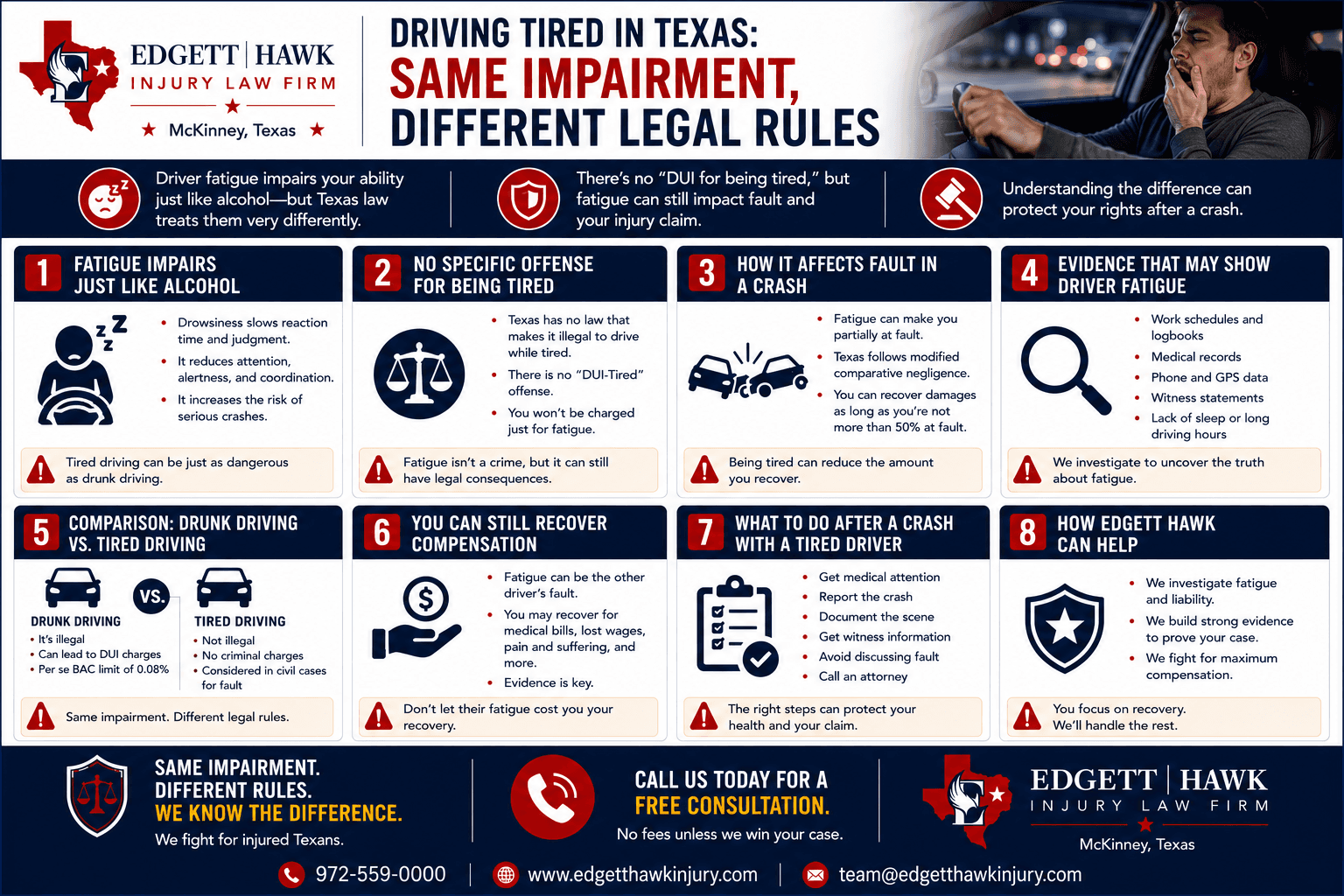
The comparison between tired driving and drunk driving gets repeated so often that it has started to sound like a slogan. It is not. It is a measured finding from a controlled study, and the numbers line up more precisely than most people expect. What almost nobody explains is the second half: Texas law responds to those two identical impairments in completely different ways. One produces a criminal charge, a chemical test, and a licence suspension. The other produces almost nothing. If you were hit by a driver who had been awake for 20 hours, that gap is the thing standing between you and a straightforward claim.
The Impairment Curve Was Measured, Not Estimated
In 1997 Drew Dawson and Kathryn Reid published a short paper in Nature titled Fatigue, alcohol and performance impairment. They tested the same subjects under sleep deprivation and under alcohol, then mapped one onto the other. The result was a rate: each additional hour of wakefulness between 10 and 26 hours produced a performance decrement equivalent to a 0.004 percent rise in blood alcohol concentration. Converted into the milestones that matter on a Texas road:
- 17 hours awake, roughly equivalent to a 0.05 BAC
- 22 hours awake, roughly equivalent to a 0.08 BAC, the Texas per se limit
- 24 hours awake, roughly equivalent to a 0.10 BAC
A nurse leaving a double shift, a contractor driving home from an out-of-town job, a parent who has been up since 4am with a sick child. None of them has had a drink, and any of them can be at the functional equivalent of the legal limit.
Texas Defines Intoxication in a Way Fatigue Cannot Trigger
Section 49.01 of the Texas Penal Code gives two routes to intoxication. The first is not having the normal use of mental or physical faculties due to alcohol, a controlled substance, a drug, a dangerous drug, a combination of those, or any other substance in the body. The second is an alcohol concentration of 0.08 or more. Fatigue satisfies neither. It is not a substance, and it produces no concentration of anything. A driver can be measurably as impaired as someone over the limit and still be, in the eyes of the intoxication statute, entirely sober. That is not an oversight in the drafting. It is a consequence of building the offence around substances that can be tested for.
There Is No Roadside Test, and That Shapes Everything Downstream
Alcohol leaves a number. Fatigue leaves nothing an officer can measure at the scene, which means the crash report often records no impairment at all, and the insurer starts from the position that the other driver simply made a mistake. Proving otherwise is done indirectly, through phone records, work schedules, and what the vehicle itself recorded. We covered that evidentiary process in detail in
our article on how drowsy driving cases get proven in Texas. This article is about the legal asymmetry sitting behind it.
The Employer Question Texas Answered in 2009
If work caused the exhaustion, the instinct is to look at the employer. Texas addressed this directly in Nabors Drilling, U.S.A., Inc. v. Escoto, decided by the Texas Supreme Court in 2009. The court held that an employer owes no duty to prevent injury caused by the fatigue of an off-duty employee, and no duty to train employees about the dangers of fatigue. A limited exception survives, but it is genuinely narrow and requires both of the following:
- Actual knowledge that the employee was impaired when they left, not general awareness that the work is tiring
- An affirmative exercise of control after discovering that incapacity, such as directing an obviously intoxicated worker to drive home
Scheduling decisions made before the shift began do not satisfy the test. Neither does a demanding rota, a culture of long hours, or knowledge that the job routinely leaves people exhausted.
Why the Court Drew the Line Where It Did
The reasoning is worth understanding rather than resenting, because it explains why the rule is unlikely to move. The court distinguished fatigue from intoxication on the ground that fatigue has no quantifiable measurement standard, and that it is produced by numerous off-duty factors an employer neither knows about nor controls, including a second job, a new baby, or insomnia. It also noted the practical problem: a Texas employer has no legal power to detain an employee after a shift ends. A duty that required employers to stop anyone showing signs of tiredness from leaving would be, in the court's framing, far reaching and onerous. Off-duty employees are therefore trusted to judge whether they are rested enough to drive.
Liability Still Lands, It Just Lands on the Driver
None of this means a fatigue crash is unrecoverable. It means the claim runs through ordinary negligence rather than through a statute. The question a jury answers is whether the driver behaved as a reasonably prudent person would have in the same circumstances, and a person who chooses to drive after 20 hours awake fails that standard on the facts alone. A specific statute makes proof easier where one exists. Its absence does not convert dangerous conduct into permitted conduct, and it does not stop a negligence claim from being filed.
Commercial Drivers Are the Exception That Proves the Rule
There is one category where fatigue does generate hard evidence, and it exists precisely because regulators built the measurement the criminal law lacks. Federal hours of service rules cap driving time for commercial operators, and electronic logging devices record compliance automatically. That produces a paper trail with timestamps, which is the closest thing to a fatigue test that exists anywhere in the system. It is also why a fatigue claim against a trucking company looks completely different from one against a private motorist, and why the employer analysis above does not transfer to that setting.
What the Asymmetry Costs You as a Claimant
Practically, the gap between the science and the law shows up as pressure on you. With no test result in the file, the cheapest position for an insurer is that the crash was an ordinary accident and that you contributed to it. Under Section 33.001 of the Civil Practice and Remedies Code your damages fall by your percentage of responsibility, and above 50 percent you recover nothing, which we explain further in
our guide to Texas comparative fault. The counter to that is evidence gathered early, while phone records still exist, employers still hold rota data, and vehicle modules have not been overwritten.
How Many Hours Without Sleep Equals the Legal Alcohol Limit?
Around 22. The 1997 Dawson and Reid study published in Nature found that each additional hour of wakefulness between 10 and 26 hours produced impairment equivalent to a 0.004 percent rise in blood alcohol concentration. That puts 17 hours awake at roughly a 0.05 BAC, 22 hours at roughly 0.08, and 24 hours at roughly 0.10. Texas sets the per se intoxication threshold at 0.08, so a driver finishing a long double shift can be functionally at the legal limit while being completely sober.
Can a Driver Be Charged With DWI in Texas for Being Exhausted?
No. Section 49.01 of the Texas Penal Code defines intoxicated as either not having the normal use of mental or physical faculties due to alcohol, a controlled substance, a drug, a dangerous drug, or a combination of substances, or having an alcohol concentration of 0.08 or more. Exhaustion is not a substance and produces no alcohol concentration, so it falls outside both prongs no matter how impaired the driver actually was.
Can You Sue an Employer in Texas When a Tired Employee Causes a Crash?
Usually not. In Nabors Drilling, U.S.A., Inc. v. Escoto, decided in 2009, the Texas Supreme Court held that an employer has no duty to prevent injury caused by the fatigue of an off-duty employee, and no duty to train employees about the dangers of fatigue. A narrow exception exists where the employer had actual knowledge the employee was impaired when leaving and then affirmatively exercised control anyway, such as directing an obviously intoxicated worker to drive home. Scheduling decisions made before the shift do not satisfy it.
Can a Fatigued Driver Be Held Liable if No Law Prohibits Drowsy Driving?
Yes. Liability in a civil injury case rests on ordinary negligence, which asks whether the driver acted as a reasonably prudent person would have under the circumstances. Choosing to drive after 20 hours awake fails that standard on its own facts. A specific statute makes proof easier where one exists, but its absence does not create permission.
What Happens if the Insurance Company Blames Me for a Fatigue Crash?
Expect it, because with no chemical test available the cheapest move for an insurer is to shift responsibility onto you. Under Section 33.001 of the Texas Civil Practice and Remedies Code your damages are reduced by your percentage of fault, and you recover nothing if your share exceeds 50 percent. Every point they attach to you is a point off what they pay, which is why early evidence preservation matters more in these cases than in most.
If Nobody Has Asked Why the Other Driver Never Braked
A crash with no skid marks, no evasive steering, and no explanation is the signature of a driver who was not conscious at the moment of impact. That question does not get asked unless somebody asks it, and the records that answer it have short lifespans. Edgett Hawk investigates fatigue crashes across North Texas, the consultation costs nothing, and there is
no attorney fee unless we recover for you. Call 972.559.0000.