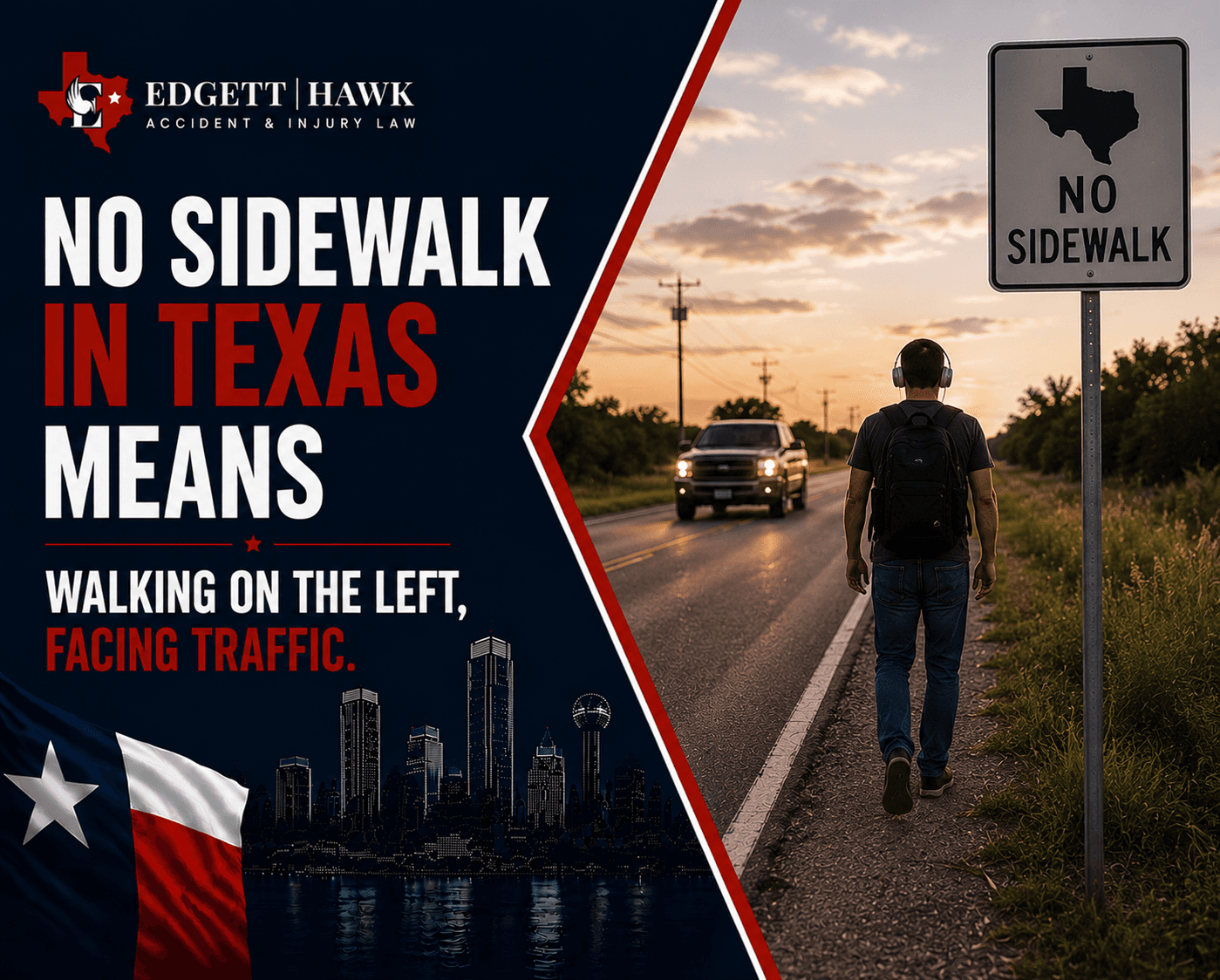
Large stretches of Texas were built without pavements, and people still have to get places. If you have ever walked a shoulder on a farm to market road, along a suburban stretch where the sidewalk simply stops, or through an area where the developer never put one in, Texas law has a specific answer about where you are supposed to be. Most people walk on the wrong side, and if they are hit, that becomes the first thing the driver's insurer raises.
The Rule Is Left Side, Facing Traffic
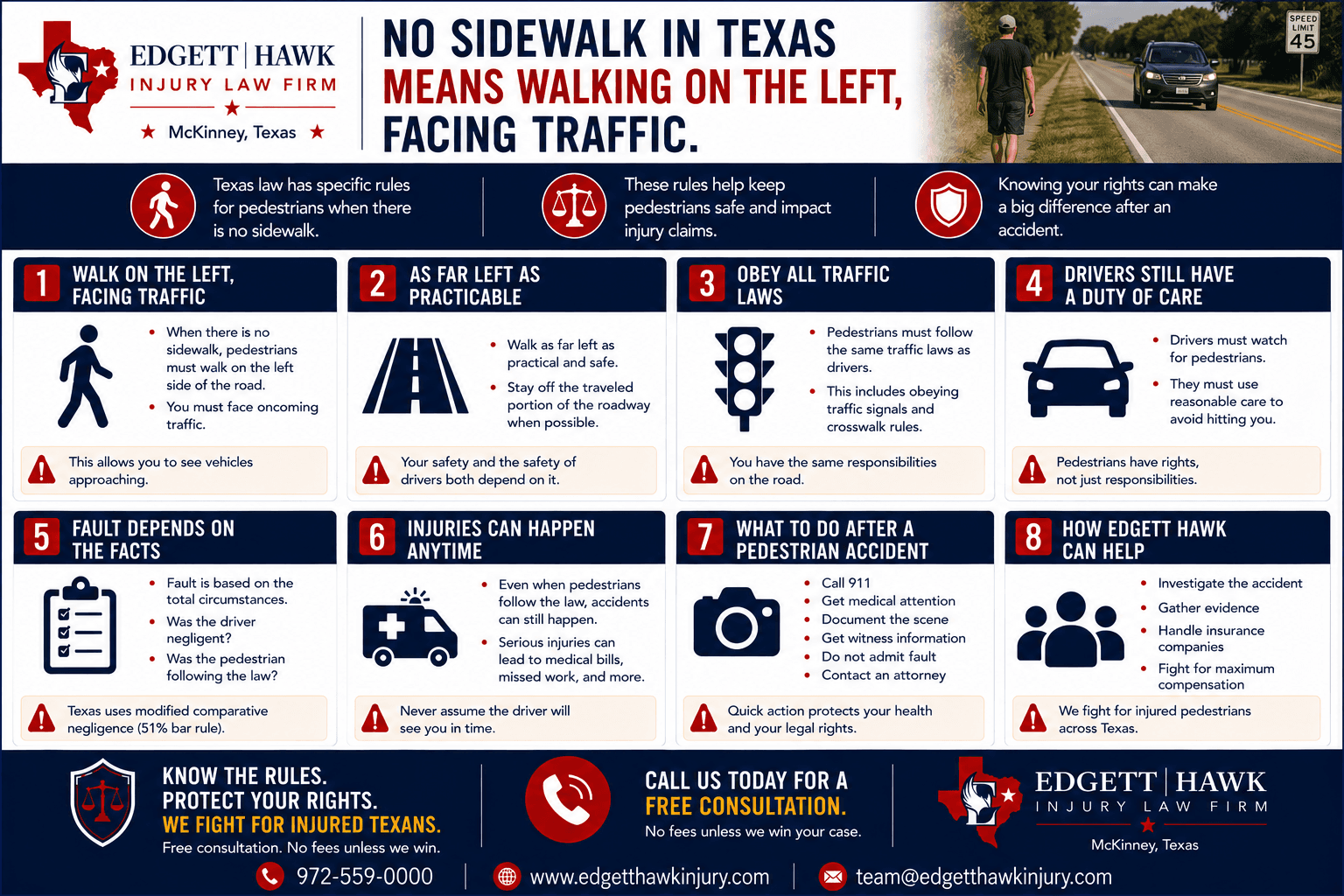
Section 552.006(b) of the Transportation Code is direct about it. If a sidewalk is not provided, a pedestrian walking along and on a highway shall walk on the left side of the roadway or the shoulder of the highway facing oncoming traffic. The reasoning is straightforward. Facing traffic means you can see a vehicle drifting toward you and step away from it. Walking with traffic at your back means the first indication is the impact. It is a rule about giving the pedestrian a chance to react, and it is the opposite of what most people do by instinct.
The Exception Written Into the Same Sentence
The obligation is not absolute, and this is the part that matters most in a real case. Section 552.006(b) applies unless the left side of the roadway or the shoulder facing oncoming traffic is obstructed or unsafe. Texas roads supply that condition constantly:
- A left shoulder that has crumbled away or narrowed to nothing
- A drainage ditch, culvert, or steep drop where the shoulder should be
- Standing water, mud, or debris after rain
- Construction or roadworks occupying the left side
- A blind curve where oncoming drivers cannot see far enough ahead
- Guardrail or barrier leaving no walkable space
Where the left side was genuinely unsafe, a pedestrian on the right was not violating the statute at all. Photographs of the roadway taken soon after the incident are usually what settles this, and conditions change fast.
Accessible Is Doing Work in Subsection (a)
Section 552.006(a) says a pedestrian may not walk along and on a roadway if an adjacent sidewalk is provided and is accessible to the pedestrian. Insurers tend to read that as a simple presence test: there was a sidewalk, therefore the pedestrian should have used it. The statute says accessible, not present. A sidewalk closed for construction, submerged after rain, blocked by parked vehicles or overgrowth, ending abruptly mid-block, or too damaged to be used by someone with a mobility aid raises a real question about whether it was accessible to that pedestrian at that moment. That is a fact question, and facts can be photographed.
The Driver's Duty Does Not Switch Off
Even where a pedestrian was in the wrong place, the driver's obligations continue. Section 552.008 requires the operator of a vehicle to exercise due care to avoid colliding with a pedestrian on a roadway, to give warning by sounding the horn when necessary, and to exercise proper precaution on observing a child or an obviously confused or incapacitated person on a roadway. Nothing in that section is conditioned on the pedestrian having complied with Section 552.006. A driver who was speeding on an unlit road, looking at a phone, or drifting onto the shoulder has breached their own duty whichever side the person was walking on.
Two Wrongs Produce Percentages, Not a Dismissal
When both parties broke a rule, Texas does not pick a winner. It apportions. Under Section 33.001 of the Civil Practice and Remedies Code, a pedestrian's damages are reduced by their percentage of responsibility and eliminated only where that percentage exceeds 50 percent. So a pedestrian walking on the right side of an unlit road who is struck by a driver doing 15 over the limit while texting is not automatically out. They are somewhere on a scale, and the position on that scale is argued from evidence rather than assumed from the statute. The mechanics are covered in
our guide to Texas comparative fault.
Crossing Is Governed Separately
Walking along a road and crossing it are different questions under different sections. Section 552.005 provides that a pedestrian crossing a roadway at a place other than a marked crosswalk, or an unmarked crosswalk at an intersection, or where a pedestrian tunnel or overhead crossing has been provided, shall yield the right of way to vehicles. It also provides that between adjacent intersections where traffic control signals are in operation, a pedestrian may cross only in a marked crosswalk. Note what this does not say. It does not make crossing elsewhere unlawful in every circumstance. It imposes a duty to yield, which is a different thing from a prohibition.
A Detail Drivers Overlook Entirely
Section 552.006(c) puts an obligation on drivers that has nothing to do with roadways. The operator of a vehicle emerging from or entering an alley, building, or private road or driveway shall stop and yield the right of way to a pedestrian approaching on a sidewalk extending across that alley, building entrance or exit, road, or driveway. Anyone who has walked past a car park exit while a driver rolled forward watching only for a gap in traffic has experienced the breach of it. In collisions at driveway mouths and shopping centre exits, this provision is often the cleanest liability point available.
What Decides These Cases in Practice
Pedestrian collisions are usually low on witnesses and high on physical evidence, and the physical evidence has a short life. The roadway condition on the day matters enormously, because whether the left side was obstructed or unsafe cannot be reconstructed from a photograph taken six months later after the shoulder has been regraded. Lighting at the actual hour matters, not lighting at noon. The final rest position of the pedestrian and the vehicle indicates the point of impact and therefore where on the road each party was. Dashcams and nearby business cameras overwrite within weeks. Where a pedestrian is seriously injured, nobody in the family is thinking about photographing a shoulder in the first fortnight, which is precisely when it needs doing.
Which Side of the Road Should You Walk On in Texas Without a Sidewalk?
The left, facing oncoming traffic. Section 552.006(b) of the Transportation Code provides that if a sidewalk is not provided, a pedestrian walking along and on a highway shall walk on the left side of the roadway or the shoulder facing oncoming traffic, unless that side is obstructed or unsafe. Walking with your back to traffic on the right is the more common habit and it is the wrong one.
Is It Illegal to Walk in the Road in Texas if There Is a Sidewalk?
Generally yes. Section 552.006(a) states that a pedestrian may not walk along and on a roadway if an adjacent sidewalk is provided and is accessible to the pedestrian. The word accessible carries weight. A sidewalk blocked by construction, flooded, overgrown, or unusable by someone in a wheelchair is arguably not accessible, which is a question of fact rather than a matter of whether concrete exists.
Can a Pedestrian Still Recover After Being Hit While Walking on the Wrong Side?
Usually yes. Walking on the wrong side may make a pedestrian partly responsible, but Texas apportions fault rather than eliminating claims. Under Section 33.001 of the Civil Practice and Remedies Code damages are reduced by your percentage of responsibility, and recovery is barred only where that share is greater than 50 percent. A driver who was speeding, distracted, or drifting onto the shoulder carries their own share regardless of which side the pedestrian was on.
What Duty Do Texas Drivers Owe to Pedestrians in the Road?
A continuing one. Section 552.008 requires a vehicle operator to exercise due care to avoid colliding with a pedestrian on a roadway, to give warning by sounding the horn when necessary, and to exercise proper precaution on observing a child or an obviously confused or incapacitated person on a roadway. That duty applies whether or not the pedestrian was where they should have been.
Do You Have to Use a Crosswalk in Texas?
Not always, but crossing elsewhere carries a duty. Under Section 552.005, a pedestrian crossing at a place other than a marked or unmarked crosswalk at an intersection, or where a pedestrian tunnel or overhead crossing is provided, must yield the right of way to vehicles. Between adjacent intersections where traffic control signals are operating, a pedestrian may cross only in a marked crosswalk.
Photograph the Shoulder Before It Changes
If someone in your family was struck walking a road with no pavement, the argument you will face is that they should not have been there. Answering it takes evidence about what the left side actually looked like that day, and that evidence degrades within weeks. Edgett Hawk investigates pedestrian collisions across North Texas, we document the roadway before it is repaired or regraded, and there is
no attorney fee unless we recover for you. Call 972.559.0000.