Nobody thinks of the radio as a risk. It is the one thing in the car that is supposed to be harmless. But if you are hurt in a wreck on a Texas road and the other side can convince a jury your music was loud enough that you missed something, the number at the bottom of your settlement changes. Not because playing music broke a law. Because of how Texas divides up fault.
Texas Has No Volume Limit for Your Car Stereo
People assume there must be a statute. There is not. The state noise provision in the Transportation Code, Section 547.604, requires every vehicle to have a muffler in working order and prohibits excessive or unusual noise. Read it closely and it is about exhaust systems and muffler cutouts. It says nothing about what is coming out of your speakers.Sound systems are left to cities. Austin, Houston, Dallas and plenty of smaller North Texas municipalities each set their own noise rules, which means the answer genuinely changes depending on which side of a city line you happen to be sitting on when the light turns green.
You Can Still Get Pulled Over, Just Not for the Reason You Think
An officer who can hear your bass from three cars back has a reason to look closer. In practice the music is rarely the citation by itself. It is the thing that draws attention, and then the stop is written up for whatever else turns up.That matters after a crash for a reason most people miss. A noise complaint or a warning in the record becomes a piece of paper the other side can point to later, and paper is what these arguments are built out of.
What Volume Actually Does Behind the Wheel
Attention is not unlimited. When a large share of it goes to processing sound, less of it is available for the road, and the loss does not feel like anything from the inside. That is the genuinely dangerous part. Drivers do not notice themselves getting slower.The effect shows up as delayed braking, missed changes in traffic ahead, and a slower read on signals and brake lights. Fractions of a second, which is exactly the margin that decides whether a crash happens at all.
The Sounds You Stop Hearing
Vision gets all the attention in conversations about distracted driving, but a car is full of information that arrives through your ears:
- Sirens, often audible well before the emergency vehicle is visible
- Another driver leaning on the horn to warn you
- Train horns at the crossings scattered across North Texas
- Your own tires losing traction, or a mechanical problem starting
- Tires locking up on the car behind you
A siren is the one that causes real legal trouble. Texas drivers have a duty to yield to an approaching emergency vehicle, and not hearing it is not a defense to failing to do it.
Where This Actually Costs You Money
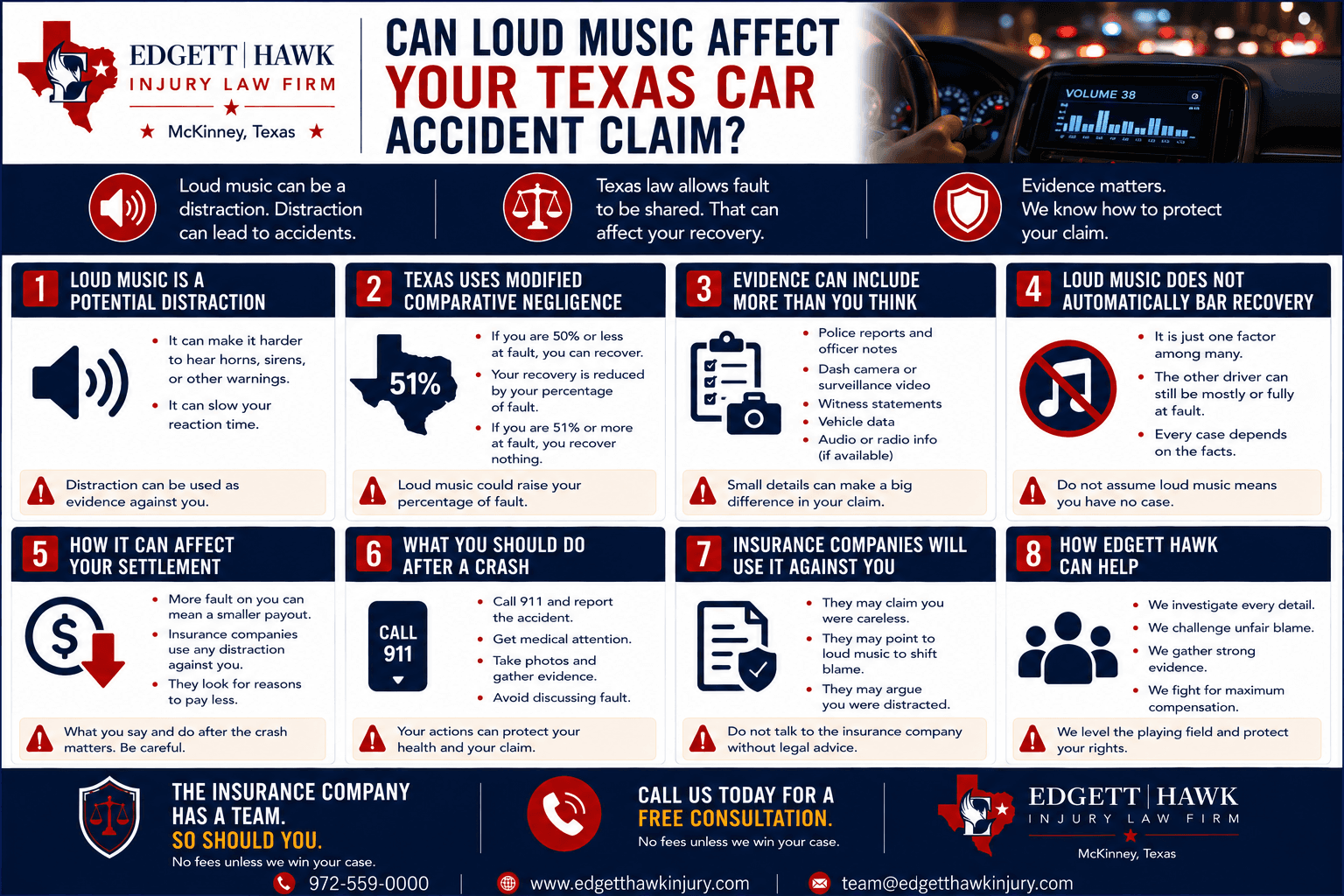
Texas follows proportionate responsibility under Chapter 33 of the Civil Practice and Remedies Code. A jury assigns each party a percentage of fault, and your recovery is reduced by your share. Section 33.001 sets the hard edge: if your percentage is greater than 50, you recover nothing.Put numbers on it. A case valued at $200,000 with 20 percent of the fault assigned to you pays $160,000. The same case at 40 percent pays $120,000. Cross 50 percent and a case a jury just valued at $200,000 pays you zero. That is why the other side works so hard to move your number up even a few points, and why a detail as small as your radio is worth their time.
How an Adjuster Turns Your Radio Into a Discount
This does not arrive as an accusation. It arrives as a friendly question during a recorded statement, somewhere in the middle, phrased like small talk. What were you listening to. Was the radio on. Did you hear them honk.
- Recorded statements taken early, before you know the questions have a purpose
- Statements from your own passengers about how loud it was
- The other driver claiming they honked and got no reaction
- Your posts and stories from earlier that day
None of that proves you did anything wrong. It does not have to. It only has to give a jury a reason to move your percentage up, and every point it moves comes straight out of what you take home.
Headphones Are Legal in Texas, Which Surprises People
Texas has no statewide ban on wearing headphones or earbuds while driving. Several states do. Texas is not one of them.That is thinner protection than it sounds. Nobody gets cited for the earbuds themselves, but if you miss a siren and fail to yield, you get cited for failing to yield, and the earbuds become the explanation of why it happened. In a claim, an explanation is worth more to the other side than a violation.
Keeping the Volume From Becoming Evidence
None of this requires driving in silence. It requires leaving yourself enough room to hear what matters:
- Set the volume so a siren or a horn still reaches you
- Turn it down in heavy traffic, in rain, and anywhere near a crossing
- Change tracks and settings before you move, not at 70 on the tollway
- Treat intersections as the place to be listening, not just looking
Is It Illegal to Play Loud Music While Driving in Texas?
There is no statewide Texas law that sets a volume limit for a car stereo. The state noise provision in the Transportation Code, Section 547.604, requires a working muffler and targets excessive exhaust noise, not your sound system. Volume from a stereo is handled by city ordinance instead, so the rule genuinely changes depending on which side of a city line you are sitting on.
Can Loud Music Make Me Partly at Fault for a Car Accident in Texas?
Yes. Texas uses proportionate responsibility under Chapter 33 of the Civil Practice and Remedies Code. A jury can assign you a percentage of fault for driving distracted, and your damages are cut by that percentage. Under Section 33.001, if your share is greater than 50 percent, you recover nothing at all.
Is It Illegal to Wear Headphones While Driving in Texas?
No. Texas has no statewide ban on headphones or earbuds behind the wheel, which surprises most people. But the absence of a ban is not protection. If you do not hear a siren and fail to yield to an emergency vehicle, you get cited for failing to yield, and the earbuds become the explanation for why it happened.
What Should I Say if an Insurance Adjuster Asks What I Was Listening To?
Nothing, until you have talked to a lawyer. That question is not small talk. It is an attempt to build a distraction argument out of your own recorded words, and you are under no obligation to give a recorded statement to the other driver's insurer.
Do Not Let a Few Percentage Points Decide What You Recover
Fault in Texas is not a yes or no question. It is a number, it is argued over, and the argument starts the day the claim is opened, usually before you have any idea it is happening.If you were hurt in a crash anywhere in North Texas and the other side is hinting that you were distracted, Edgett Hawk Injury Law Firm in McKinney can push back before that number hardens. Scott Edgett and Michael Hawk have spent decades keeping insurers from shifting blame onto injured people. Call us for a free consultation. There is no obligation, and you pay nothing unless we recover for you.