A pileup on I-35 or the LBJ is not one accident with several victims. It is a stack of separate collisions, each with its own set of facts about who could have stopped and who could not. That structure changes the legal question completely. In a two-car crash the argument is whether the other driver was negligent. In an eight-car chain reaction almost everyone was negligent to some degree, and the argument becomes what percentage each of them gets, because in Texas that number decides not just who is blamed but what you are actually able to collect.
The Jury Assigns a Percentage to Everyone Involved
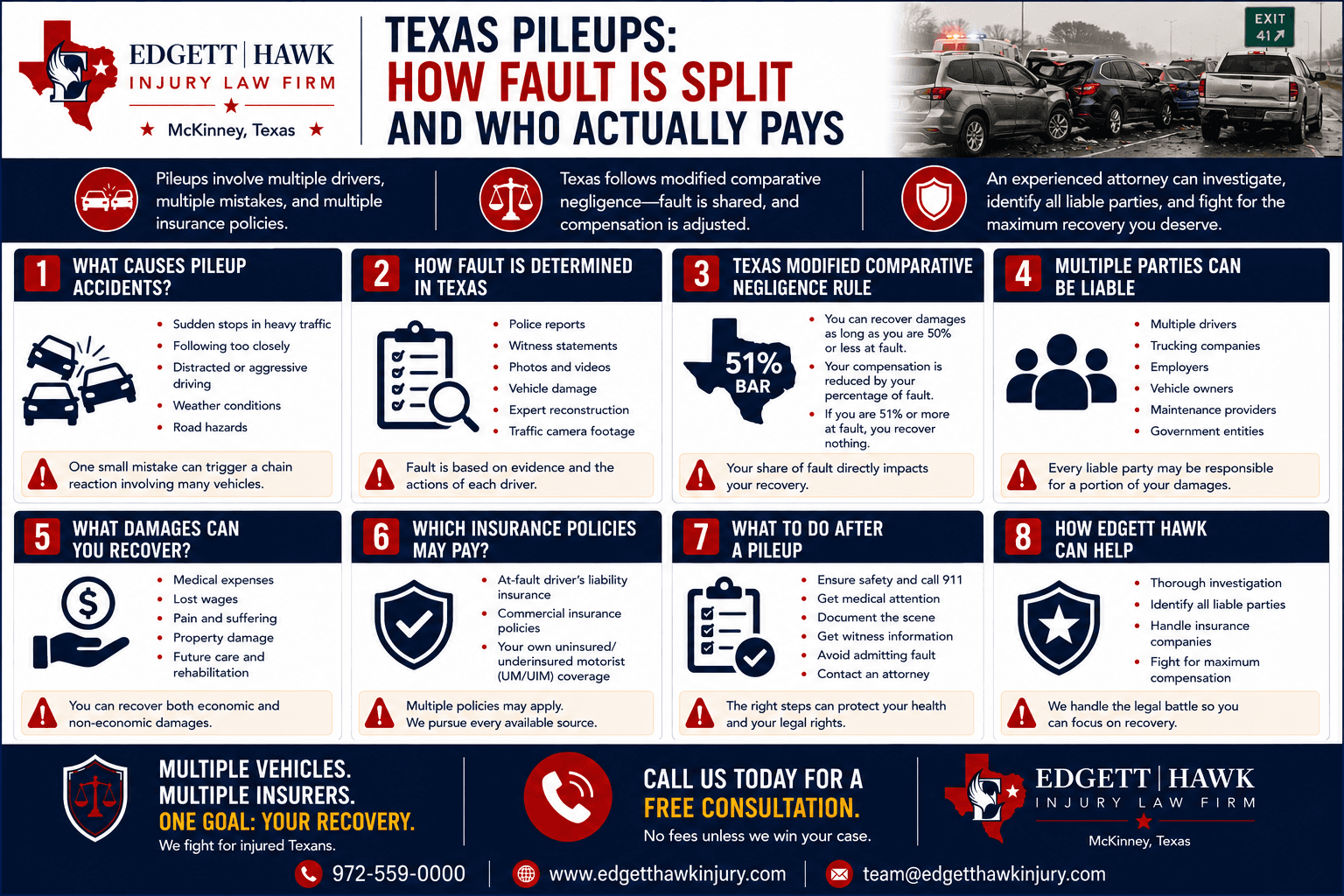
Section 33.003 of the Civil Practice and Remedies Code sets the mechanism. For each cause of action, the trier of fact determines the percentage of responsibility, stated in whole numbers, for each claimant, each defendant, each settling person, and each responsible third party who has been designated under Section 33.004. That list matters. It includes people who already settled and left the case, and it includes people who were never sued at all. The statute also bars submitting a question about anyone's conduct without sufficient evidence to support it, which is the practical limit on how far a defendant can spread the blame.
Defendants Can Add People You Never Sued
This is the part that surprises claimants most, and it is worth understanding before it happens. Under Section 33.004, a defendant may file a motion for leave to designate someone as a responsible third party, generally on or before the 60th day before the trial date unless the court finds good cause for a later filing. The court shall grant that leave unless another party objects on or before the 15th day after the motion is served. There is also a distinct route for unknown people: if the defendant pleads, within 60 days of its original answer, facts sufficient to show a reasonable probability that an unknown person committed a criminal act that caused the loss, the court shall grant leave to designate that unknown person. The purpose is arithmetic. Every percentage point the jury hands to a designated third party is a point that no defendant in the room has to pay.
The 50 Percent Line That Decides What You Collect
Section 33.013(a) is the default rule: a liable defendant is liable to a claimant only for the percentage of the damages equal to that defendant's own percentage of responsibility. Section 33.013(b) is the exception: a defendant becomes jointly and severally liable for the damages recoverable by the claimant when the percentage attributed to that defendant is greater than 50 percent. In a pileup, percentages are usually spread thin enough that nobody crosses that line, and the consequence is concrete:
- Damages of 400,000 dollars, with fault split 30, 25, 25 and 20 percent across four drivers
- No defendant exceeds 50 percent, so nobody is jointly and severally liable
- You pursue 120,000 from the first, 100,000 from the second, 100,000 from the third and 80,000 from the fourth
- If the 25 percent driver carries no insurance and no assets, that 100,000 is simply not there
Which Is Why the Uninsured Link Is the Real Risk
In a two-car crash, one uninsured defendant means one problem. In a pileup, the chance that at least one driver in the chain is uninsured or minimally insured is high, and that driver's share does not redistribute to the others. It is deducted from what you can realistically recover. Your own uninsured and underinsured motorist coverage is normally the only mechanism that fills the gap, and it is worth reading your declarations page in the first week rather than the sixth month. We cover how multiple policies interact in
our article on whether insurance follows the car or the driver in Texas.
The Phantom Driver Nobody Can Serve
Many pileups begin with a vehicle that is never part of the wreck. Someone cuts across three lanes, a car brakes hard to avoid them, and the chain starts behind that avoidance. The driver who caused it keeps going and is never identified. Defendants will point at that car, and Section 33.004 gives them a route to put an unknown person on the verdict form in the right circumstances. Establishing whether that vehicle existed, and what it actually did, comes down to dashcam footage, toll gantry and business camera coverage, and witness accounts gathered while people still remember the sequence. All of that has a short shelf life.
Rear-Ending Someone Is Strong Evidence, Not a Verdict
Section 545.062 of the Transportation Code requires a driver to maintain an assured clear distance from the vehicle ahead, close enough in practice to the two-second rule most people were taught. A violation can support a negligence per se claim, so the driver who struck from behind starts in a difficult position. In a chain reaction that position is often wrong. The middle vehicle is frequently pushed into the car in front by the impact from behind, meaning its contact with the leading car was not caused by its own following distance at all. Crush patterns, the order of impacts, and event data recorder readings are what separate those two stories, and they are the difference between being a defendant and being a claimant.
Weather Lowers the Speed Limit, Not the Standard
Fog on the way into Fort Worth, sudden rain on the Dallas North Tollway, or ice on an overpass will be offered as the explanation for a pileup, usually by everyone at once. Texas law does not treat weather as an excuse. The duty is to drive reasonably for the conditions that actually exist, which means conditions that reduce visibility or traction raise what is required of a driver rather than lowering it. Travelling at the posted limit in freezing fog is not automatically reasonable. The presence of bad weather tends to expand the number of drivers who share responsibility rather than clearing any of them.
The Evidence That Sets Percentages Disappears First
Percentages are argued from physical evidence, and in a multi-vehicle wreck that evidence scatters faster than in any other kind of case. Vehicles are towed to different yards and released for salvage within weeks, taking their event data recorders with them. Commercial units in the chain carry telematics that overwrite. Roadway debris fields are cleared within hours. Because your recovery depends on the percentage assigned to each solvent defendant, and that percentage is set by reconstruction rather than by argument, the window to preserve it is the first few weeks. This is also why an early low offer from one carrier is worth treating carefully, as we explain in
our guide to Texas comparative fault.
Who Is at Fault in a Multi-Car Pileup in Texas?
Usually several people at once. Under Section 33.003 of the Civil Practice and Remedies Code, the trier of fact assigns a percentage of responsibility, stated in whole numbers, to each claimant, each defendant, each settling person, and each responsible third party who has been designated. There is no single at-fault driver in the way there often is in a two-car collision. There is a set of percentages that has to add up to 100.
What Happens if One Driver in a Texas Pileup Has No Insurance?
That percentage of your damages usually goes uncollected. Section 33.013(a) makes a liable defendant responsible only for the percentage of damages equal to their own percentage of responsibility, so an uninsured driver assigned 25 percent leaves a 25 percent hole rather than shifting that share onto the other defendants. Your own uninsured and underinsured motorist coverage is normally the only thing that fills it, which is why checking your declarations page early matters.
When Is a Defendant Liable for the Whole Judgment in Texas?
Only when their share exceeds half. Section 33.013(b) makes a liable defendant jointly and severally liable for the damages recoverable by the claimant if the percentage of responsibility attributed to that defendant is greater than 50 percent. At 50 percent or below, each defendant pays only their own slice, which is why the apportionment fight in a pileup is really a fight about collectability.
Can a Defendant Blame a Driver Who Left the Scene?
Yes, and it is a standard tactic. Section 33.004 lets a defendant move for leave to designate a responsible third party, generally on or before the 60th day before trial, and the court shall grant leave unless another party objects within 15 days of service. There is also a specific route for designating an unknown person where the defendant pleads facts showing a reasonable probability that an unknown person committed a criminal act that caused the loss. Every percentage the jury gives to a phantom driver is a percentage no defendant has to pay.
Is the Rear Driver Always at Fault in a Texas Chain-Reaction Crash?
No. Section 545.062 of the Transportation Code requires a driver to keep an assured clear distance, and a violation can support a negligence per se claim, so rear-ending someone is strong evidence of fault. It is not conclusive. In a chain reaction the middle vehicle is frequently pushed into the car ahead by the impact behind it, and physical evidence about which contact happened first can move that driver from defendant to claimant.
Do Not Let the First Carrier Set Your Percentage
In a pileup the insurers talk to each other before they talk to you, and the first settlement offered is usually from the carrier most confident it can keep its driver's percentage low. Accepting it makes that driver a settling person whose share still appears on the verdict form, without adding anything to what the remaining defendants owe. Edgett Hawk handles multi-vehicle crashes across North Texas, the consultation is free, and there is
no attorney fee unless we recover for you. Call 972.559.0000 before you sign a release.