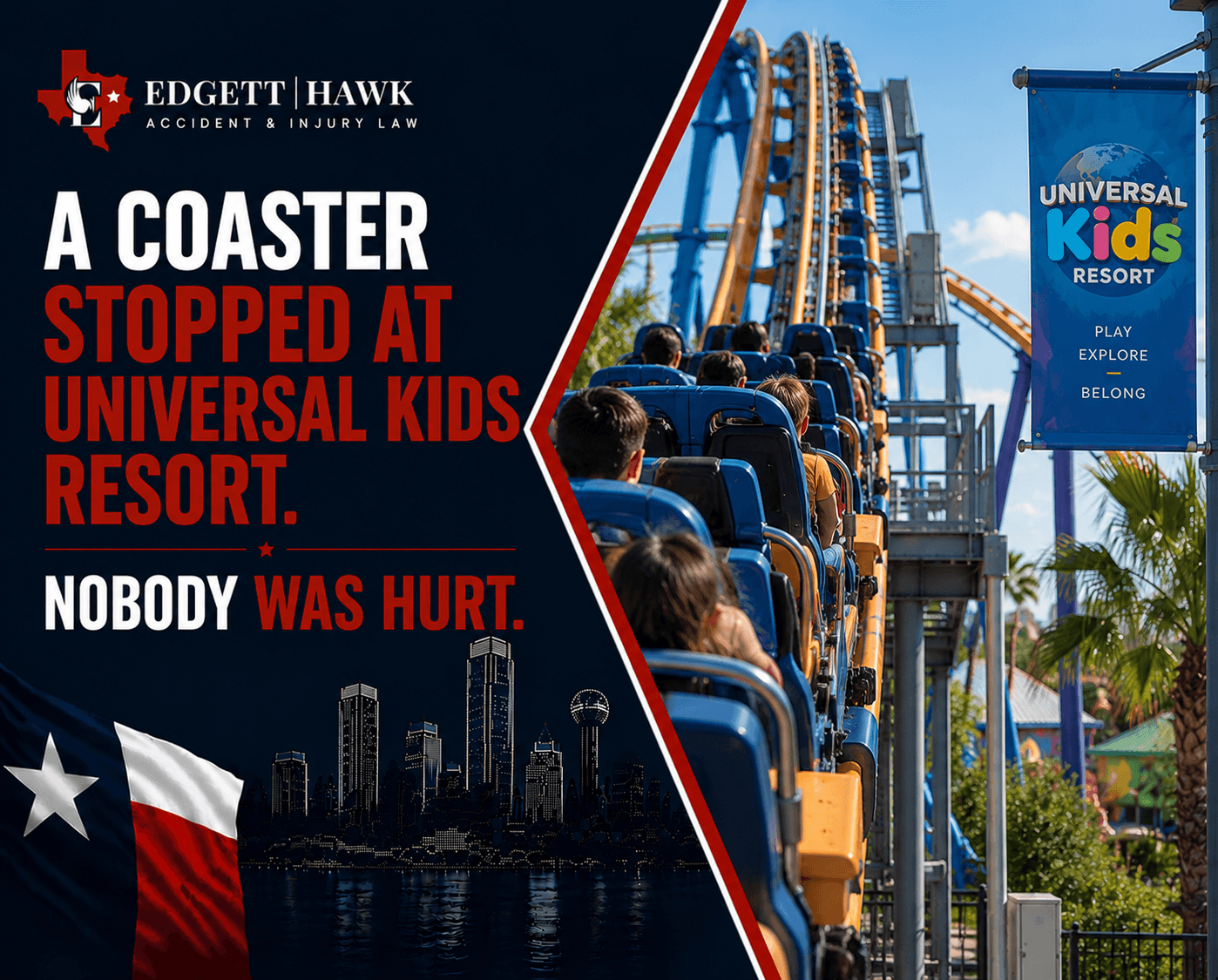
A coaster at Universal Kids Resort in Frisco stopped mid-course, and for several minutes a group of riders sat suspended above a theme park in triple-digit North Texas heat. The Frisco Fire Department came out as a precaution, the guests came down safely, and no injuries were reported. By any sensible measure the system worked. It is still worth walking through, because the distance between that afternoon and a serious injury claim is short, and almost everything that would decide such a claim was created and started expiring the moment the ride stopped.
What Was Reported, and What Was Not
The facts are narrow and worth stating precisely. A technical issue caused the attraction to stop temporarily. Riders, including at least one child whose family later spoke to reporters, were held in place for a matter of minutes. The Frisco Fire Department responded as a precaution while guests exited the attraction. A resort spokesperson attributed the stop to a technical issue.
No injuries were reported. The family's stated concern was not the mechanical failure but the heat, and how long children might be held in it.That last detail is the one worth holding onto, because it is the part of the incident most likely to produce an actual injury on a different day. Nothing here implies that anyone was harmed or that the park did anything wrong. What follows is about the different scenario: what Texas law would ask if a malfunction did injure someone.
A Ride Stopping Is Usually the Safety System Working
Modern attractions are built to fail in a specific direction. Control systems run on interlocks and sensors, and when a reading falls outside tolerance the ride stops rather than continuing. A restraint sensor that does not confirm, a block zone conflict between two trains, a power fluctuation, a wind reading, or a fault the controller cannot clear will all halt the ride automatically and hold it until a technician clears it by hand.That is designed behavior, and an automatic stop is not by itself evidence of negligence. It is also why the legally interesting question is never the stop. It is what happened in the minutes afterward: how long guests were held, in what conditions, whether anyone communicated with them, and how they were brought down.
The Four Ways a Ride Failure Becomes a Claim
When a malfunction does cause injury in Texas, the claim almost always traces back to one of four failures, and they point at different defendants.
- Mechanical failure. A cable, weld, bearing, hydraulic line, brake or drive component fails. Depending on whether the part was defective or simply neglected, this points at the manufacturer, the maintenance provider, or the operator.
- Operator error. Dispatching before the platform is clear, skipping the restraint check, overriding a fault to keep the queue moving, or mishandling the stop itself. This is the operator's responsibility through its employee, and training records become central.
- Maintenance failure. Missed service intervals, deferred repairs, repeated faults logged and cleared without diagnosis, or repairs done outside the manufacturer's specification. The maintenance history is usually the whole case.
- Restraint failure. A lap bar or harness that does not lock, releases mid-ride, or is not adjusted for a small child at the bottom of the height requirement. On a park built for young children, restraint geometry is a recurring issue rather than an exotic one.
Evacuation Is Where Uneventful Stoppages Turn Into Injuries
The stop rarely hurts anyone. The recovery sometimes does, and this is the part of an incident that families underestimate.
- Heat exposure while held in place, which in a North Texas summer is the most realistic injury path on a stopped ride and the one this particular incident put in plain view.
- Falls during an evacuation down maintenance stairs, catwalks or ladders that were designed for technicians rather than for a frightened six-year-old.
- Panic responses, including a rider attempting to release a restraint or climb out unaided while waiting.
- Medical episodes triggered or worsened by the wait, including dehydration, fainting, asthma and cardiac events.
- Psychological injury in children, which Texas recognizes as mental anguish and which is real enough to require treatment after a prolonged suspension at height.
Each of these is judged on the reasonableness of the operator's response: how quickly staff reached the riders, whether water and shade were brought, whether anyone explained what was happening, and whether the evacuation route was appropriate for the people being evacuated.
The Evidence Has a Shelf Life
This is the practical reason to act quickly after any ride incident, injury or not. Most of what proves these cases belongs to the park, and most of it is on a deletion schedule that nobody pauses for a family that has not yet decided whether to make a claim.
- Surveillance and on-ride camera footage, commonly overwritten on a rolling cycle measured in weeks rather than months.
- Ride control system fault and error logs, which record exactly what tripped and when, and which roll over on their own schedule.
- Maintenance and daily inspection records, which are superseded at the next service.
- The annual inspection certificate and insurance filing required under Chapter 2151 of the Occupations Code, which the operator files with the state before July 1 each year.
- Quarterly injury reports under Section 2151.103, which establish whether the same attraction has produced reportable injuries before.
- Training and certification records for the operator on duty.
- The incident report taken at guest services, and the names of other riders on the same cycle.
A written preservation demand sent early is frequently the difference between a provable claim and an argument. After that, routine overwriting stops being routine.
Report It Before You Leave the Park
If something happens on a ride, have guest services complete an incident report before you go home, even when nobody appears hurt. Children minimize, adrenaline masks symptoms, and head and neck injuries frequently present the next morning. A report created on the day anchors the date, the ride and the circumstances.Describe what happened plainly and avoid speculating about what caused it, because a guess recorded on a park form tends to resurface later as an admission. Photograph the completed report before you hand it back and keep the reference number. If a voucher, refund or free return visit is offered in exchange for a signature, read what the signature releases before signing it.
Who Would Be on the Hook
Liability for a ride injury is rarely confined to the company whose name is on the gate, and this matters because each additional defendant brings separate insurance. The same analysis appears in our
guide for parents on Universal Kids Resort injury claims, applied across the whole property rather than to the rides alone.
- The park operator, for its employees, its training, its inspection routine and its handling of the incident.
- The ride manufacturer, under a products liability claim governed by Chapter 82 of the Civil Practice and Remedies Code where the design or manufacture was defective. The attractions at this park were built by outside ride companies, and that claim does not require proving the park itself was careless.
- A maintenance contractor, where servicing is outsourced and the work was performed badly, late, or not at all.
- A component supplier, where a restraint, sensor, cable or fastener failed as a discrete part.
- A staffing agency, where the person operating the attraction was not directly employed by the park.
What Texas Requires of the Park on Paper
Texas does not leave ride safety entirely to the operator. Chapter 2151 of the Occupations Code, the
Amusement Ride Safety Inspection and Insurance Act, requires an annual inspection by the operator's insurer or a contractor of that insurer, a written inspection certificate, and the filing of that certificate and the liability policy with the state before July 1 each year. Class B rides, the category covering larger permanent attractions, must carry at least $1,000,000 in bodily injury coverage per occurrence, or a $1,500,000 combined single limit.Section 2151.103 adds the record-keeping piece, requiring operators to log and report injuries that caused death or required treatment by a physician or registered professional, on a quarterly basis. Taken together these filings are the closest thing Texas has to a public safety history for an individual ride, and they are obtainable.
Heat Changes the Analysis in North Texas
It is worth returning to what the family in this incident actually said, because it points at the most realistic risk on a stopped ride in Frisco. Their concern was not that the coaster had failed. It was how long children would be held in the heat while it was resolved. Visitors have publicly described limited shade across the park, and North Texas runs triple-digit heat indices for long stretches of the season.That combination is foreseeable rather than freakish, and foreseeability is the whole of a negligence analysis. A downtime plan that is adequate in March is not automatically adequate in August, and whether an operator adjusted for the conditions it knew it had is a question a court can answer from the park's own records.
If the Injured Rider Is a Child, the Deadlines Change
At a park built for young children, most injured riders are minors, and that changes the timetable in a way parents are rarely told. Section 16.003 of the Civil Practice and Remedies Code sets the usual two-year limit that
our guide to the Texas filing deadline explains, but Section 16.001 treats being under 18 as a legal disability that pauses the clock. A child generally has until two years after their eighteenth birthday. A parent's own claim for the medical bills they paid gets no such extension and runs out on the ordinary two years.None of that helps with evidence. A claim filed years later is a claim with no footage, no current maintenance records and no reachable witnesses, which is why the useful work still happens in the first weeks regardless of how long the statute allows.
Expect an Argument About Whose Fault It Was
Where a rider is injured, the operator's first move is usually to shift responsibility onto the family: that a posted height or health restriction was disregarded, that a child was not properly supervised, that someone stood up or reached out during the ride. Texas applies proportionate responsibility under Chapter 33 of the Civil Practice and Remedies Code, so damages are reduced by the claimant's share of fault and a claimant found more than fifty percent at fault recovers nothing.
Our explainer on Texas comparative fault covers how that rule is applied in practice.These arguments are answered with documents rather than with recollection. If the park measured a child and admitted them to the attraction, the admission decision was the park's. If a restriction existed but nobody enforced it at the gate, that failure belongs to the operator too. More detail on how these cases are built sits on our
amusement park injuries page.
What to Do in the First Forty-Eight Hours
If a ride incident does injure someone in your family, the window that matters is short and mostly administrative.
- Get medical attention the same day, from a doctor rather than the park's first aid station, and say explicitly where and how it happened.
- File the incident report before leaving, and keep the reference number.
- Photograph the ride, the restraint, the posted restrictions, the evacuation route and any visible injuries, then photograph the injuries again over the following days.
- Collect names and numbers for other riders on the same cycle, who will be unreachable within hours.
- Write down the timeline while it is fresh, including how long the ride was stopped and when staff arrived.
- Send a preservation demand, or have a lawyer send one, before footage cycles.
- Decline recorded statements to an insurer until you have advice.
Frequently Asked Questions
Common questions about ride malfunctions at Universal Kids Resort and what Texas law requires.
Was anyone injured in the Universal Kids Resort ride malfunction in Frisco?
No. According to reporting on the incident, a technical issue caused a coaster at Universal Kids Resort to stop temporarily, leaving riders briefly suspended. The Frisco Fire Department responded as a precaution, guests exited the attraction safely, and no injuries were reported. Nothing in this article suggests otherwise. The incident is discussed here because it illustrates how a routine ride stoppage works, and what the legal picture would look like in the different situation where a malfunction does cause harm.
Is a ride stopping mid-course actually a malfunction?
Usually it is the safety system doing its job. Modern rides run on interlocks and sensors that halt the ride automatically when a reading falls outside tolerance, which can be a restraint sensor, a block zone conflict, a wind or power condition, or a fault the control system cannot immediately clear. An automatic stop is designed behavior. The legal question is never the stop itself, but what happened next: how long guests were held, in what conditions, and how the evacuation was handled.
What evidence matters if a child is injured on a theme park ride in Texas?
Surveillance and ride-camera footage, the ride control system's fault and error logs, maintenance and daily inspection records, the annual inspection certificate required under Chapter 2151 of the Occupations Code, the operator's quarterly injury reports, training records for the operator on duty, the incident report taken at guest services, and contact details for other riders. Most of it is held by the park and most of it has a short life. Footage is commonly overwritten within weeks and control logs roll over, so a preservation demand sent early is often what decides whether a claim is provable.
Who is liable when an amusement ride malfunctions in Texas?
It depends on which link failed, and more than one party is often responsible. The operator answers for its employees, its training, its inspection routine and its evacuation procedure. The ride manufacturer can face a products liability claim under Chapter 82 of the Civil Practice and Remedies Code where the design or build was defective, which does not require proving the park was careless. A maintenance contractor answers for servicing it performed, and a component supplier for a part that failed on its own. Identifying each one early matters because every party carries separate insurance.
Should you report a ride incident before leaving the park in Texas?
Yes, and this is the step people most often skip. Ask guest services to complete an incident report, describe what happened factually without speculating about cause, photograph the report before handing it back, and write down its reference number. A report created on the day is the hardest evidence for a defendant to dispute. An injury first raised weeks later invites the argument that it happened somewhere else. Do not accept a voucher or a refund in exchange for a signature without knowing what the signature releases.
Talk to a Frisco Ride Accident Attorney
Nobody was hurt when that coaster stopped, and this article should not be read as suggesting otherwise. But the same incident on a hotter afternoon, with a longer hold or a harder evacuation, produces a claim that turns entirely on records the park controls and routinely overwrites. Edgett & Hawk Accident & Injury Law handles amusement park and
premises liability claims across Collin County from our office in McKinney, minutes from the resort.If your child was hurt at the park, our
full guide for Frisco parents covers documentation, liability and the longer filing deadline that applies to children. Consultations are free and we work on contingency, so there is no fee unless we recover for you.