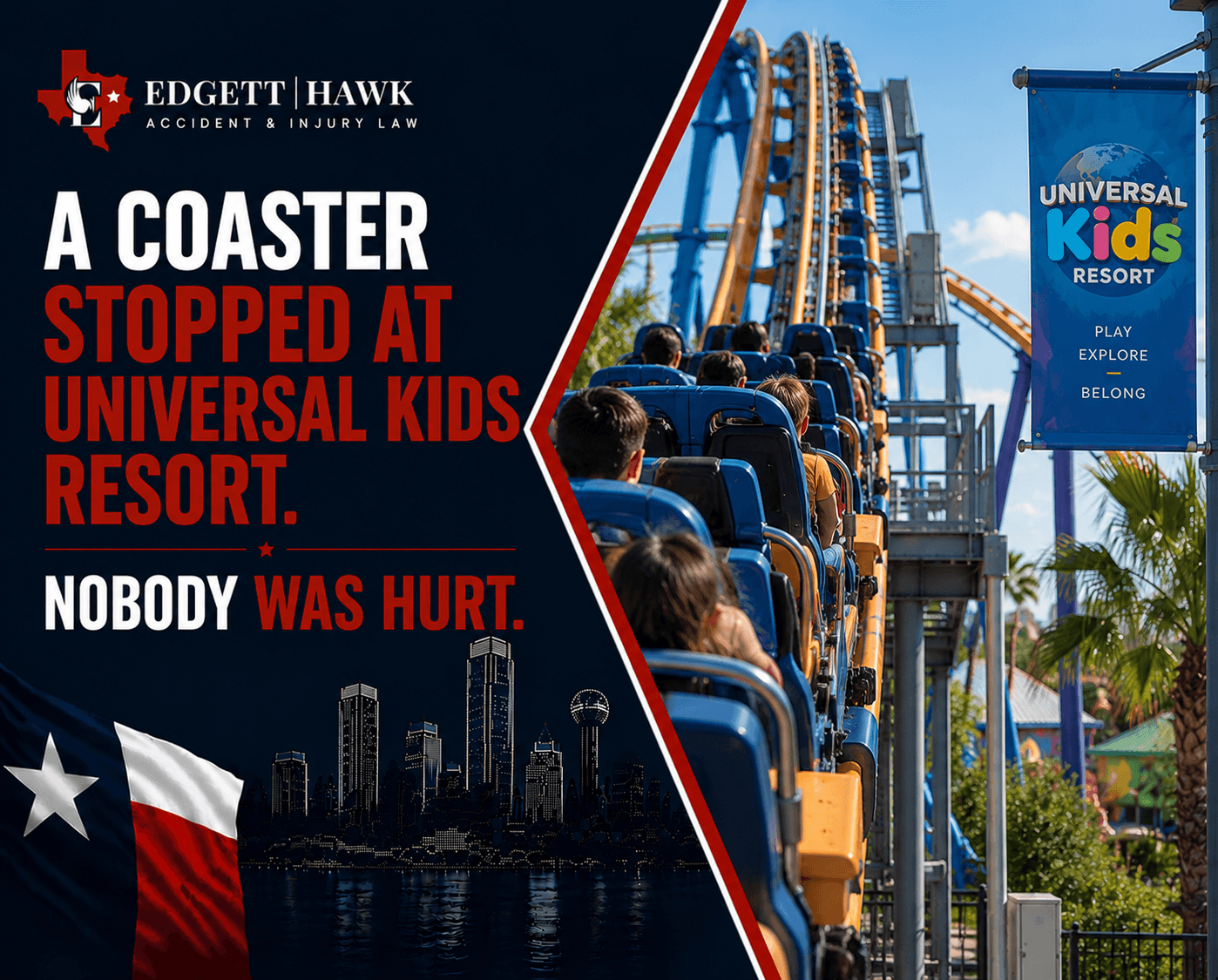
Universal Kids Resort opened in Frisco on July 1, 2026, and for most Collin County families it has been what it advertised: thirty-two acres built deliberately small, for children too young for the parks in Orlando. But a park designed around young children is also a park where the people getting hurt are young children, and a child's injury claim in Texas does not work the way most parents assume. It runs on a longer clock than the parent's own claim. It survives more of what gets signed at the gate than people expect. And it depends almost entirely on what was documented in the twenty minutes after it happened, before anyone left the property.

Thirty-Two Acres of Premises Liability in Collin County
The resort sits in Frisco, inside Collin County, a short drive from our office in McKinney. It opened to the public on July 1, 2026 following an early preview the week before, and it is operated by Universal Destinations and Experiences, the NBCUniversal division that runs the company's parks. Seven themed lands, a three hundred room hotel, and an attraction mix aimed squarely at children who in many cases are riding something mechanical for the first time in their lives. Legally, none of that is exotic. It is a commercial property open to paying guests, which in Texas means premises liability. It is also an amusement ride operator, which means a specific licensing statute sits on top of the ordinary negligence rules. Those two things together are what a claim is built from, and they are covered in more depth on our
amusement park injuries page.
Your Child Is an Invitee, Which Is the Best Starting Position Texas Offers
A family that buys a ticket enters for the park's commercial benefit. That makes every one of them an invitee and gives them the highest duty Texas premises law recognizes. The occupier can be liable where it had actual or constructive knowledge of a condition on the premises, the condition posed an unreasonable risk of harm, the occupier failed to exercise reasonable care to reduce or eliminate that risk, and the failure proximately caused the injury. Those are the same elements set out in
our guide to Texas premises liability, and the element that decides most cases is the first one.Actual knowledge means someone at the park knew. Constructive knowledge means the condition was there long enough that reasonable inspection should have found it, which is why the length of time a spill sat on a walkway, or a guardrail stayed loose, tends to matter more than how dangerous it looks in a photograph. A park operating at summer capacity generates an enormous volume of internal records on exactly that question, and those records are obtainable.
Texas Regulates These Rides, and the Paperwork Is Discoverable
Most parents have no idea this statute exists. Chapter 2151 of the Texas Occupations Code, the
Amusement Ride Safety Inspection and Insurance Act, imposes concrete obligations on anyone operating a ride in this state, and it produces a paper trail that exists whether or not a family ever speaks to a lawyer.
- Each ride must be inspected at least once a year by the operator's insurer, or by someone the insurer contracts with, and the operator must obtain a written certificate of that inspection.
- The inspection certificate and the insurance policy must be filed with the state before July 1 of each year, and within fifteen days of any additional inspection.
- For Class B rides, the category covering the larger permanent attractions, the operator must carry at least $1,000,000 in bodily injury and $500,000 in property damage coverage per occurrence, or a $1,500,000 combined single limit.
- Section 2151.103 requires the operator to keep injury records and file quarterly reports describing injuries that resulted in death or required treatment by a physician or registered professional. First aid and minor injuries are excluded, and no report is due for a quarter with nothing reportable.
- The implementing rules sit at 28 Texas Administrative Code Sections 5.9001 through 5.9014.
None of this creates a cause of action by itself. What it creates is evidence. An inspection certificate names the inspector and dates the inspection. A quarterly injury report establishes whether the same attraction had hurt someone before. A missing or late filing is a fact a defendant has to explain. This is the category of proof that decides amusement park cases, and it is also the category that is easiest to lose by waiting.
The Injuries a Children's Park Actually Produces
The attraction mix at a park built for young children shifts the injury profile away from high-speed coaster trauma and toward a more mundane and more frequent set of harms.
- Ride and restraint injuries, including a lap bar or harness that did not secure properly on a child at the low end of the height requirement, or a sudden stop on a coaster or spinning attraction.
- Slips, trips and falls on wet queue flooring, splash-zone runoff, food court spills, uneven paving and transitions between surfaces.
- Playground and climbing area injuries, where the questions are fall height, surfacing material, equipment spacing and whether the structure was age-appropriate for the children admitted to it.
- Water play injuries, including slip hazards around splash features, drain and suction hazards, inadequate lifeguarding and water quality.
- Heat-related illness, which in North Texas summer conditions is not a freak event but a foreseeable one.
- Injuries from defective or poorly maintained equipment, where the claim may lie against the manufacturer rather than the park.
- Employee negligence, including improper restraint checks, dispatching a ride before the platform is clear, mishandling an evacuation, or failing to enforce a posted restriction.
- Inadequate warnings, where a height, age or health restriction existed but was not posted, not legible, or not enforced by the operator at the gate.
Heat Is the Frisco Problem Nobody Plans For
North Texas runs triple-digit heat indices for long stretches of the summer, and visitors to the park have publicly described limited shade across the grounds. For a park marketed to toddlers and young children, that combination is legally relevant in a way it would not be at an adult park. Small children dehydrate faster, regulate temperature less effectively, and cannot reliably tell an adult what is happening to them.A heat illness claim does not turn on the temperature, which nobody controls. It turns on whether the operator's response to a known and recurring condition was reasonable: whether shade and misting were available along the queues that actually hold people, whether water was accessible without leaving a line, whether staff were trained to recognize heat illness in a five-year-old, and whether the park had already been told about the same problem. That last point is why prior complaints, internal maintenance requests and public reviews matter as evidence rather than as commentary.
Who Can Be Liable Is Rarely Just the Park
Treating the operating company as the only defendant is the most common and most expensive mistake in these cases, because each additional responsible party carries separate insurance.
- The operating entity, for the condition of the grounds, the conduct of its employees and its enforcement of its own rules.
- The ride manufacturer. The attractions at this park were built by outside ride companies, and a design or manufacturing defect supports a products liability claim under Chapter 82 of the Civil Practice and Remedies Code, which does not depend on proving the park was careless.
- A maintenance or inspection contractor, where servicing is outsourced and the work was done badly or not at all.
- A component supplier, where a restraint, sensor, cable or fastener failed as a discrete part.
- A staffing agency, where the employee who ran the attraction was not directly employed by the park.
- Third-party vendors operating food, retail or attractions inside the park under their own name and their own policy.
What to Photograph Before You Leave the Property
The park's version of events will be assembled from its own cameras and its own staff. A family's version has to be assembled on the spot, and almost every parent who calls us later wishes they had taken thirty more seconds.
- The condition itself, before anyone cleans, repairs or cordons it, from close range and from far enough back that the location is identifiable.
- The ride, attraction or structure involved, including its name plate and every posted height, age or health restriction.
- The signage that was there, and a clear shot of the place where signage was not.
- Your child's shoes and clothing, which defeat the argument that footwear caused the fall.
- The visible injuries that day, then again over the next several days as bruising and swelling develop.
- Employee name badges, and the names of anyone who responded.
- Wristbands, tickets, parking receipts and app order confirmations, which timestamp your presence.
- The incident report itself, photographed before you hand it back, along with its reference number.
Report It Before You Leave, and Get the Number
Guest services will complete an incident report. Do it, even when the injury looks minor and the child has stopped crying, because a report created on the day is the single hardest piece of evidence for a defendant to argue with later. An injury first raised three weeks after the visit invites the argument that it happened somewhere else entirely.Two cautions. Describe what happened factually and decline to speculate about cause or fault, because a guess written into a park form has a way of reappearing. And do not accept a voucher, a refund or a season pass in exchange for a signature without knowing what the signature releases.
A Doctor, Not the First Aid Station
First aid on site is for treatment, not for documentation. It produces a log entry, not a diagnosis, and it will not establish causation. Children also mask injuries, and head injuries in particular present late. Take the child to an emergency room, an urgent care or the pediatrician the same day, tell the provider explicitly where and how it happened, and keep going to the follow-ups. Gaps in treatment are the most reliable way to reduce the value of an otherwise strong claim, as
our guide to medical documentation explains.
What You Signed at the Gate Is Not the End of It
Parents routinely assume that a release printed on a ticket, a waiver clicked through in an app, or a form signed for a play structure has closed the door. In Texas it is considerably less settled than that.A release of a party's own negligence is enforceable in Texas only if it satisfies the express negligence doctrine, meaning the intent to release negligence is stated in specific terms within the four corners of the document, and only if it is conspicuous enough that a reasonable person would notice it. Boilerplate buried in small print frequently fails both tests. Separately, Texas courts have been reluctant to treat a parent's signature as extinguishing a child's own cause of action, which belongs to the child rather than to the parent. Whether a specific release accomplishes anything depends on its wording and on the facts, which is precisely why it should be read by someone rather than assumed to be fatal.
Your Child's Deadline Is Not Your Deadline
This is the part that surprises people most. Section 16.003 of the Civil Practice and Remedies Code gives two years from the date of injury for a personal injury claim, and that is the number
our guide to the Texas filing deadline is built around. But Section 16.001 treats being under 18 as a legal disability that tolls the limitations period, so a child generally has until two years after their eighteenth birthday, which is the twentieth birthday.The parent's own claim does not get that. A parent's claim for the medical expenses they paid runs on the ordinary two years and can quietly expire while the child's claim is still years from running. And neither deadline governs the one that actually decides cases: surveillance footage at a park is routinely overwritten within weeks, maintenance records get superseded at the next service, and staff who witnessed the incident are seasonal and gone by autumn. A claim brought in year eighteen is a claim with no evidence in it.
What the Park Will Say About Your Supervision
Expect the operator to argue that the parent is partly at fault: that the child was too small for the attraction, that a posted restriction was ignored, that the child was unsupervised, that a warning was there to be read. This matters because Texas applies proportionate responsibility under Chapter 33 of the Civil Practice and Remedies Code. Damages are reduced by the claimant's share of fault, and a claimant found more than fifty percent responsible recovers nothing, a rule
our explainer on Texas comparative fault covers in full.The answer to that argument is usually documentary rather than rhetorical. If the park admitted a child to an attraction, the park measured and admitted that child. If a restriction was posted but unenforced at the gate, the enforcement failure is the park's. Photographs of the actual signage, taken on the day, are what settle these disputes, which is the practical reason the photograph list above matters so much.
What These Claims Are Worth
Texas law allows recovery for the full consequences of the injury, not just the emergency room bill.
- Medical expenses already incurred and the cost of care the child will need in future.
- Physical pain and mental anguish, past and future.
- Physical impairment and disfigurement, which carry real weight for a child facing scarring or a permanent limitation.
- A parent's lost wages from time taken off to manage treatment.
- Loss of the child's future earning capacity where an injury is permanent.
- Exemplary damages in the narrow cases involving gross negligence.
Claims involving minors also carry procedural requirements that adult claims do not. A settlement on behalf of a child generally requires court approval, and frequently a guardian ad litem, which is a protection for the child rather than an obstacle but does mean these cases are not settled over the phone.
Frequently Asked Questions
The questions Frisco parents ask us most often after an injury at the resort, answered briefly.
Can you sue Universal Kids Resort in Frisco if your child is injured?
You can, and the claim is an ordinary Texas premises liability and negligence claim rather than anything unique to theme parks. A paying guest is an invitee, which is the highest duty Texas premises law recognizes. The operator can be liable where it had actual or constructive knowledge of a condition on the property, the condition posed an unreasonable risk of harm, the operator failed to exercise reasonable care to reduce or eliminate it, and that failure caused the injury. Where the injury came from a ride rather than the grounds, a second track opens up against whoever manufactured or maintained the equipment.
How long does a child have to file an amusement park injury claim in Texas?
Longer than a parent does. Section 16.003 of the Civil Practice and Remedies Code gives two years for a personal injury claim, but Section 16.001 treats being under 18 as a legal disability that tolls the limitations period. A child generally has until two years after turning 18, which is the 20th birthday. The parent's own claim for the medical expenses they paid runs on the ordinary two years and can expire while the child's is still alive. The practical deadline is shorter than either, because surveillance footage and maintenance records do not wait for a statute to run.
Does the waiver on the ticket stop a claim at a Texas theme park?
Not automatically. Texas enforces a release of a party's own negligence only if it satisfies the express negligence doctrine, meaning the intent is stated in specific terms within the four corners of the document, and only if it is conspicuous enough that a reasonable person would notice it. Separately, Texas courts have been reluctant to treat a parent's signature as extinguishing a child's own cause of action, which belongs to the child rather than the parent. Whether a particular release does anything depends on its wording and on the facts, which is why it is worth having it read rather than assumed.
What records does a Texas amusement park have to keep?
Chapter 2151 of the Occupations Code, the Amusement Ride Safety Inspection and Insurance Act, requires the operator to have each ride inspected at least once a year by the insurer or someone the insurer contracts with, to obtain a written certificate, and to file that certificate and the insurance policy with the state before July 1 each year. Section 2151.103 requires the operator to keep injury records and file quarterly reports covering injuries that caused death or required treatment by a physician or registered professional, excluding first aid and minor injuries. That paperwork exists whether or not anyone intends to sue, and it is obtainable.
What should parents photograph before leaving a theme park after an injury?
The condition itself before anyone cleans or repairs it, from several distances so the surroundings are identifiable. The specific ride, attraction or play structure, including its name plate and any posted height, age or health restriction. Signage, or the absence of it. Shoes and clothing. The child's visible injuries that day, and again over the following days as bruising develops. Every employee name badge you can get. The wristbands, tickets and receipts that prove you were there and when. Photograph the incident report before you hand it back, and write down its number.
Who besides the park can be liable for a ride injury in Texas?
Often several parties. The operating entity is the obvious one, but the rides at a park like this are built by outside manufacturers, and a design or manufacturing defect supports a separate products liability claim under Chapter 82 of the Civil Practice and Remedies Code. Maintenance is frequently contracted out, which puts the contractor in play. So can a staffing company whose employee ran the ride, a component supplier whose restraint or sensor failed, and a vendor operating a concession or attraction under its own name inside the park. Identifying every responsible party early matters, because each one carries separate insurance.
Talk to a Frisco Amusement Park Injury Lawyer
If your child was hurt at Universal Kids Resort, the useful work happens early: preserving footage before it cycles, requesting inspection certificates and injury reports while they are current, and identifying every party with a policy before anyone is asked to sign anything. Edgett & Hawk Accident & Injury Law handles premises and child injury claims across Collin County from our office in McKinney, minutes from the park. Our companion article on
the ride malfunction reported at the resort covers what happens when the equipment itself is the problem.Consultations are free, and we work on contingency, which means no fee unless we recover for you. If you are weighing whether a claim is worth pursuing at all,
how no win no fee actually works in Texas is a reasonable place to start.