Electric vehicles are no longer unusual on Texas roads. They are in the school pickup line in Frisco and stacked three deep at the lights on Custer Road. What has not caught up is the assumption that a crash involving one works like any other crash. In several specific ways it does not, and the differences show up in who gets hurt, what happens at the scene afterward, and what an insurance company decides your vehicle was worth.
EVs Are Good at Protecting the People Inside Them
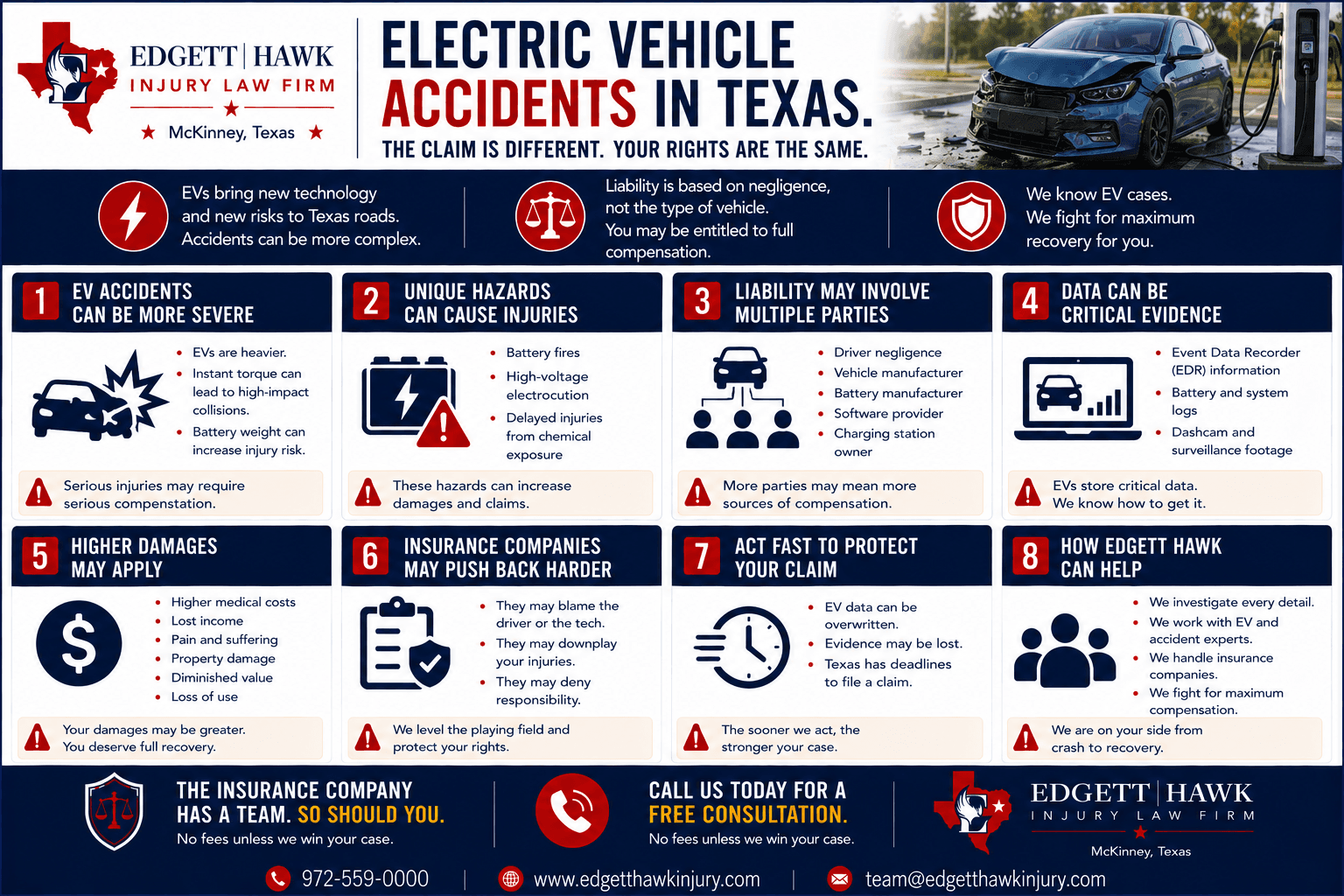
Start with what the testing actually shows, because there is a lot of noise on this subject. Crash testing has repeatedly found that electric vehicles protect their own occupants as well as comparable gas vehicles, and in some cases better. A heavy floor mounted battery gives a low center of gravity and a structure that handles impact well.The concern safety researchers have raised is not about the EV driver. It is about everyone the EV shares the road with.
The Weight Is the Whole Story
A battery pack is enormously heavy, and it pushes these vehicles well above what a comparable gas car weighs. The Insurance Institute for Highway Safety has been openly uneasy about what that means as heavier vehicles become a larger share of traffic.The physics are not complicated. When two vehicles collide, the heavier one pushes the lighter one backward. Forces go down for the people in the heavy vehicle and up for the people in the light one, at the same impact speed, with the same seat belts and the same airbags. Extra mass also means longer stopping distances, so a heavier vehicle covers more ground between the moment a driver reacts and the moment the car actually stops.
The Silence Problem Is Real, and Partly Addressed
An electric drivetrain at low speed makes almost no sound. Pedestrians, cyclists, and especially people who are blind or have low vision have historically relied on engine noise to know a car is moving toward them in a parking lot or at a crosswalk.Federal regulators responded with Motor Vehicle Safety Standard 141, which requires hybrids and EVs to emit an alert sound in reverse and below roughly 18 miles per hour. That has been mandatory for vehicles built since September 1, 2020. The gap worth knowing about is everything older than that. Hybrids and EVs built before the rule took effect were never required to have the system, and plenty of them are still on Texas roads, silent at exactly the speeds where people step out in front of them.
Battery Fires Do Not Behave Like Gasoline Fires
This is where the difference is starkest and least understood. A damaged lithium-ion battery retains what investigators call stranded energy, and that creates hazards that do not exist with a ruptured fuel tank.
- Electric shock risk from damaged high voltage components
- Thermal runaway, where temperature and pressure climb out of control
- Reignition hours or even days after a fire was apparently extinguished
- Hazards that continue during towing and in the storage yard
The National Transportation Safety Board has investigated crashes where all of the damaged batteries reignited after firefighters believed the fire was out, and has found that manufacturers' emergency response guides often lack the vehicle specific detail responders need. If an EV in your crash burned, that is not a closed chapter when the fire truck leaves.
Why Texas Insurers Total EVs So Quickly
People are regularly shocked to be told their electric vehicle is a total loss after damage that would have been a repair on a gas car. The reason is a Texas rule interacting with an EV economics problem.Section 501.091 of the Transportation Code sets the standard: a vehicle is a total loss when the cost of repairs reaches the actual cash value the vehicle had immediately before the damage. Texas uses a full 100 percent threshold, not the 75 or 80 percent figure that circulates online. Two things push EVs across that line early. Repairs are expensive, because battery packs and the structure around them are costly to work on and often cannot be sectioned or partially replaced. Meanwhile resale values on used EVs have dropped hard, which lowers the actual cash value the repair estimate is measured against. Expensive repairs chasing a falling value is a fast route to a total loss.
Why That Matters Beyond the Car
A total loss determination is not just about the vehicle. It sets the property damage number, it affects whether you are made whole on a car you may still owe money on, and it often becomes the first place an insurer establishes a posture in your claim.It is also frequently the moment the vehicle gets hauled off and disposed of, which is a problem if the crash involved a defect, a fire, or a dispute about how the collision happened. Once the car is gone, so is a good deal of the evidence.
The Upside: These Cars Record Everything
Modern electric vehicles are heavily instrumented. They log speed, acceleration, braking, steering input, driver assistance system status, and in many cases camera data, often with far more granularity than a conventional event data recorder captures.In a disputed liability case that data can settle an argument that would otherwise come down to two drivers telling different stories. It only helps if somebody moves to preserve it before the vehicle is released, wiped, or sold at salvage, which can happen within weeks.
Are Electric Vehicles More Dangerous in a Crash?
Not for the people inside them. Crash testing has consistently found EVs protect their own occupants as well as or better than comparable gas vehicles. The concern raised by safety researchers runs the other direction. Because battery packs make these vehicles substantially heavier, the people at greater risk are those in the lighter vehicle and pedestrians.
Do Electric Cars Have to Make Noise in Texas?
Yes, under federal rather than Texas law. Federal Motor Vehicle Safety Standard 141 requires hybrids and EVs to emit an alert sound in reverse and at speeds below roughly 18 miles per hour, and compliance has been mandatory for vehicles built since September 1, 2020. Older hybrids and EVs on Texas roads were never required to have it and many are effectively silent.
Why Did My Insurance Company Total My EV After a Moderate Crash?
Texas uses a 100 percent total loss threshold. Under Section 501.091 of the Transportation Code, a vehicle is a total loss when repair costs reach the actual cash value it had immediately before the damage. EVs get there faster because battery and structural repairs are expensive while resale values have fallen quickly, so the repair estimate catches up to the vehicle's value sooner than it would on a gas car.
What Should I Know if the Electric Vehicle in My Crash Caught Fire?
Damaged lithium-ion batteries hold what investigators call stranded energy, which creates both electric shock risk and the possibility of reignition. The National Transportation Safety Board has documented crash-damaged EV batteries reigniting after firefighters believed the fire was out. Stay well clear, let trained responders handle it, and make sure the vehicle is preserved rather than quietly scrapped.
If an Electric Vehicle Was Involved, Move Faster Than Usual
None of this is an argument against electric vehicles. It is an argument for understanding that the crash you were in has moving parts a routine fender bender does not: a weight mismatch that may explain your injuries, a vehicle that may have been silent when it should not have been, a battery that may still be a hazard, and a stack of recorded data with a short shelf life.If you were hurt in a crash involving an electric vehicle anywhere in North Texas, Edgett Hawk Injury Law Firm in McKinney can move to preserve the vehicle data and the vehicle itself while both still exist. Scott Edgett and Michael Hawk have spent decades on cases where the evidence decides the outcome. Call us for a free consultation. There is no obligation, and you pay nothing unless we recover for you.